
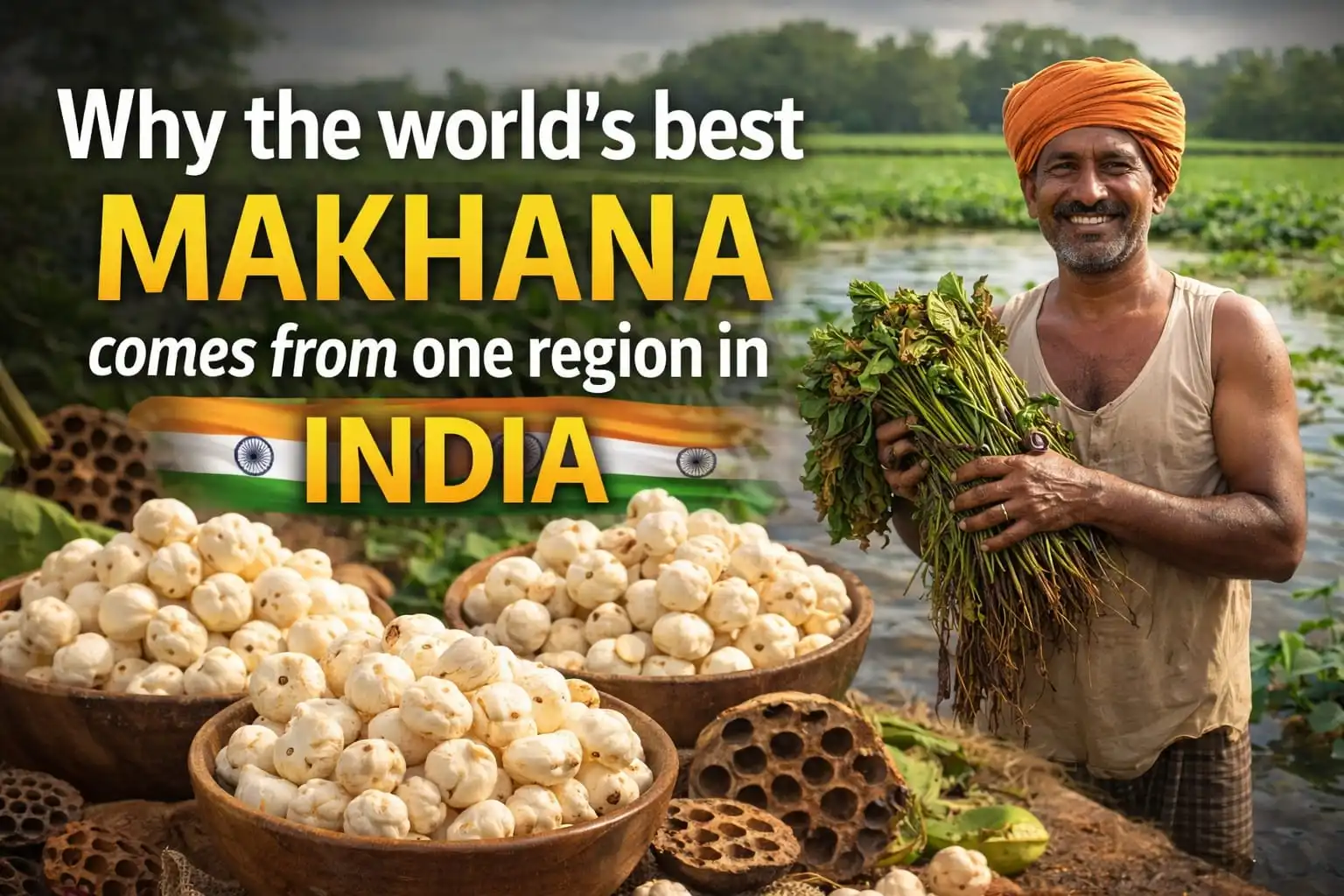
Bihar's Mithila region has been growing makhana for over 500 years. Here's what makes it irreplaceable.
If you've ever opened a bag of roasted makhana and wondered where it came from, the answer is almost certainly the same: a network of shallow freshwater ponds spread across northern Bihar, India — a region called Mithila.
Bihar produces over 90% of the world's makhana supply. But this isn't simply a story of agricultural scale. It's a story of a very specific landscape, a very specific climate, and generations of farmers who developed skills so specialized that no other region has been able to replicate what they do.
This is what makes Mithila makhana different — and why origin matters more with this crop than almost any other.
What Exactly Is Makhana?
Before understanding why Bihar produces the best makhana, it helps to understand what makhana actually is.
Makhana — known internationally as fox nuts or lotus seeds — is the popped seed of the Euryale ferox plant, a species of water lily that grows in still or slow-moving freshwater. The seeds are harvested from the muddy floor of ponds, sun-dried, then roasted at high heat until they pop into the round, white, airy kernels familiar to anyone who has snacked on them.
The final product is naturally:
- Gluten-free
- High in plant-based protein
- Rich in magnesium, potassium, and antioxidants
- Low in saturated fat
It has been part of Indian cuisine and Ayurvedic medicine for centuries — used in festive sweets, curries, and as a fasting food. More recently, it has found a new global audience as a clean-label snack ingredient, driven by the rise of health-conscious eating worldwide.
But here's the thing: the nutritional quality, size, texture, and taste of makhana vary enormously depending on where it is grown. And that's where Bihar's story becomes remarkable.
The Geography That Makes It Possible
Mithila is not just a cultural region — it's a landscape shaped by rivers.
The northern Bihar plains sit at the foothills of the Himalayas, fed by a network of rivers including the Ganga, Kosi, Gandak, and Bagmati. Over centuries, these rivers have deposited layer upon layer of alluvial silt across the floodplains, creating some of the most fertile agricultural land in Asia.
More importantly for makhana, the flooding patterns of these rivers have created thousands of natural ox-bow lakes, seasonal wetlands, and shallow ponds — exactly the kind of still, mineral-rich freshwater environment in which Euryale ferox thrives.
The key districts of this belt include:
- Darbhanga — the commercial heart of the makhana trade
- Madhubani — known for premium-quality, traditionally processed fox nuts
- Purnia and Katihar — large-scale wetland cultivation zones
- Supaul, Saharsa, Araria, and Sitamarhi — each with their own producing communities and microecosystems
What makes this geography so hard to replicate is that it isn't engineered. The ponds are naturally fed, the soil is naturally replenished every monsoon, and the ecosystem has been in equilibrium for centuries. Attempts to cultivate makhana in controlled or artificial environments in other regions have consistently produced smaller seeds, inconsistent texture, and lower nutritional density.
The Secret Beneath: Soil That Shapes Size and Quality
Most people think of makhana as an aquatic crop — and it is. But what lies beneath the water matters just as much as the water itself.
The floor of Bihar's makhana ponds is composed of silty loam — a fine, nutrient-dense sediment continuously refreshed by river flooding. This soil is naturally high in organic matter, silica, calcium, and iron. These minerals are directly absorbed by the Euryale ferox plant and ultimately concentrate in the seeds.
The result, in practical terms, is makhana that is measurably larger, denser, and more uniformly white after popping than fox nuts grown elsewhere. Premium Bihar makhana — particularly from the Madhubani and Darbhanga areas — is graded by size, and the largest grade (locally called Suta) can be almost twice the diameter of makhana grown in other parts of India.
For consumers, this translates directly into a better eating experience: a more satisfying crunch, cleaner flavor, and longer shelf life.
A Climate Built for This Crop
The Euryale ferox plant is fussy. It needs warm temperatures to grow, adequate water depth, and a precise seasonal rhythm — a hot growing season followed by a period dry enough to allow harvesting and processing.
Bihar's climate delivers all of this naturally:
- Monsoon season (June–September) fills the ponds and triggers the lotus growth cycle
- Post-monsoon warmth (October–November) matures the seeds at the pond floor
- Dry winter months (December–February) allow farmers to enter ponds and harvest
- Mild spring (March–April) is the primary processing and popping season
This seasonal rhythm is not something that can be replicated with irrigation or climate control at meaningful scale. It is one of the core reasons why makhana cultivation has remained concentrated in this specific corridor of India for so long.
The Human Side: 500 Years of Inherited Skill
Geography and climate explain why Bihar can grow exceptional makhana. They don't fully explain why it consistently does.
That part of the story is about people.
Makhana cultivation in Mithila is primarily associated with a farming community called the Mallah, who have been cultivating and processing fox nuts for generations. The knowledge they carry — about pond management, seed selection, harvesting timing, and the precise art of popping — is not written down anywhere. It is learned by watching, doing, and refining over years.
Harvesting: Underwater by Hand
The makhana harvest is one of the most physically demanding agricultural practices in India. Farmers — many of whom have been doing this since childhood — wade or dive into chest-deep pond water and use their feet and hands to locate and collect mature seeds from the muddy floor. The ability to identify ripe seeds by touch, and to work efficiently in murky cold water, is a skill that takes years to develop.
Popping: Temperature, Timing, and Touch
After sun-drying, makhana seeds are roasted in large iron pans over wood fires. The roasting must reach a precise temperature — hot enough to cause the seed to pop, but not so hot that it burns or loses its white color. Experienced processors can judge this by the sound, smell, and color of the seeds in the pan — without any thermometer or timer.
The popping moment itself requires quick reflexes: the seed is struck against a hard surface at exactly the right moment to produce the characteristic round, expanded kernel. Do it too early, and the center is dense. Too late, and the kernel shatters.
This combination of sensory judgment and physical technique is the reason that attempts to mechanize makhana processing have so far failed to match the quality of hand-processed Bihar makhana.
The GI Tag: When Geography Becomes Official
In 2022, Mithila Makhana received a Geographical Indication (GI) tag from the Government of India — one of the most significant official recognitions a regional food product can receive.
A GI tag functions similarly to the designations used for Champagne, Darjeeling Tea, or Parmigiano-Reggiano. It legally certifies that a product with this name can only originate from a defined geographical area, and that its quality is inseparably tied to that origin.
For Mithila Makhana, the GI tag confirms what farmers and food experts have known for centuries: that the combination of Mithila's soil, water, climate, and human skill produces a product that is genuinely distinct — and that no imitation or substitute grown elsewhere carries the same character.
For international consumers increasingly interested in provenance and authenticity, the GI tag provides exactly that assurance.
Why Makhana Is Taking Over Global Snacking
Makhana has been eaten in India for centuries, but its global profile has risen sharply in the last decade — and for good reason.
As consumers in North America, Europe, the Middle East, and across Asia have moved toward snacks that are high in protein, low in calories, and free from common allergens, makhana has emerged as a near-perfect fit. It is naturally:
- Vegan and plant-based
- Gluten-free and allergen-friendly
- Minimally processed when roasted simply
- Versatile — eaten plain, spiced, or used as an ingredient in everything from trail mix to curry to dessert
Indian diaspora communities around the world — many of whom grew up eating makhana during religious fasting periods or as a festive snack — have introduced it to broader audiences in their adopted countries. Health food stores, clean-label snack brands, and international grocery chains have all taken notice.
Also Checkout: makhana manufacturer in India
What Makes Mithila Makhana Different: A Summary
Factor | What It Delivers |
River-fed alluvial soil | Larger seeds, higher mineral content |
Natural wetland ecosystem | Optimal growing conditions, impossible to fully replicate |
Ideal seasonal climate | Natural growth and harvest rhythm |
500+ years of farming tradition | Unmatched harvesting and processing skill |
GI tag certification | Verified authenticity and regional quality assurance |
The Cultural and Geographical Identity of Mithila Makhana
What makes Mithila makhana extraordinary is that it cannot be reduced to any single factor. It is not just the soil, or just the climate, or just the skill of the farmers — it is all of these things working together, in a specific place, over a very long time.
That is the nature of great regional foods. Champagne is not just sparkling wine; it is sparkling wine made in Champagne, from those grapes, in that chalk, by those methods. Darjeeling tea is not just tea; it is tea grown at that altitude, in that mist, with those cultivars.
Mithila makhana is not just fox nuts. It is a product of one of the world's most distinctive agricultural landscapes — and every kernel carries that geography with it.
You Can Also Read More About: From Pond to Packet How Makhana is Harvested and Processed
FAQ’s
1. Why does Bihar produce the best makhana in the world?
Bihar produces the best makhana because of its natural wetlands, fertile soil, and suitable climate. These conditions create the ideal environment for lotus plants to grow, which helps produce high-quality fox nuts with better size, color, and texture.
2. Which region in Bihar is famous for makhana production?
The Mithila region of Bihar is widely known for makhana cultivation. Districts such as Darbhanga, Madhubani, Purnia, and Katihar are among the major areas where large quantities of makhana are grown and processed.
3. How much makhana is produced in Bihar?
Bihar accounts for the majority of makhana production in India and contributes a significant share to the global supply of fox nuts.
4. What makes Mithila makhana unique?
Mithila makhana is known for its large size, bright white color, and crunchy texture. The product has also received a Geographical Indication (GI) tag, which recognizes its unique quality and regional origin.
5. Why do importers source makhana from Bihar?
Importers prefer sourcing makhana from Bihar because the region offers consistent quality, reliable bulk supply, and traditional processing expertise that ensures premium-grade fox nuts.