
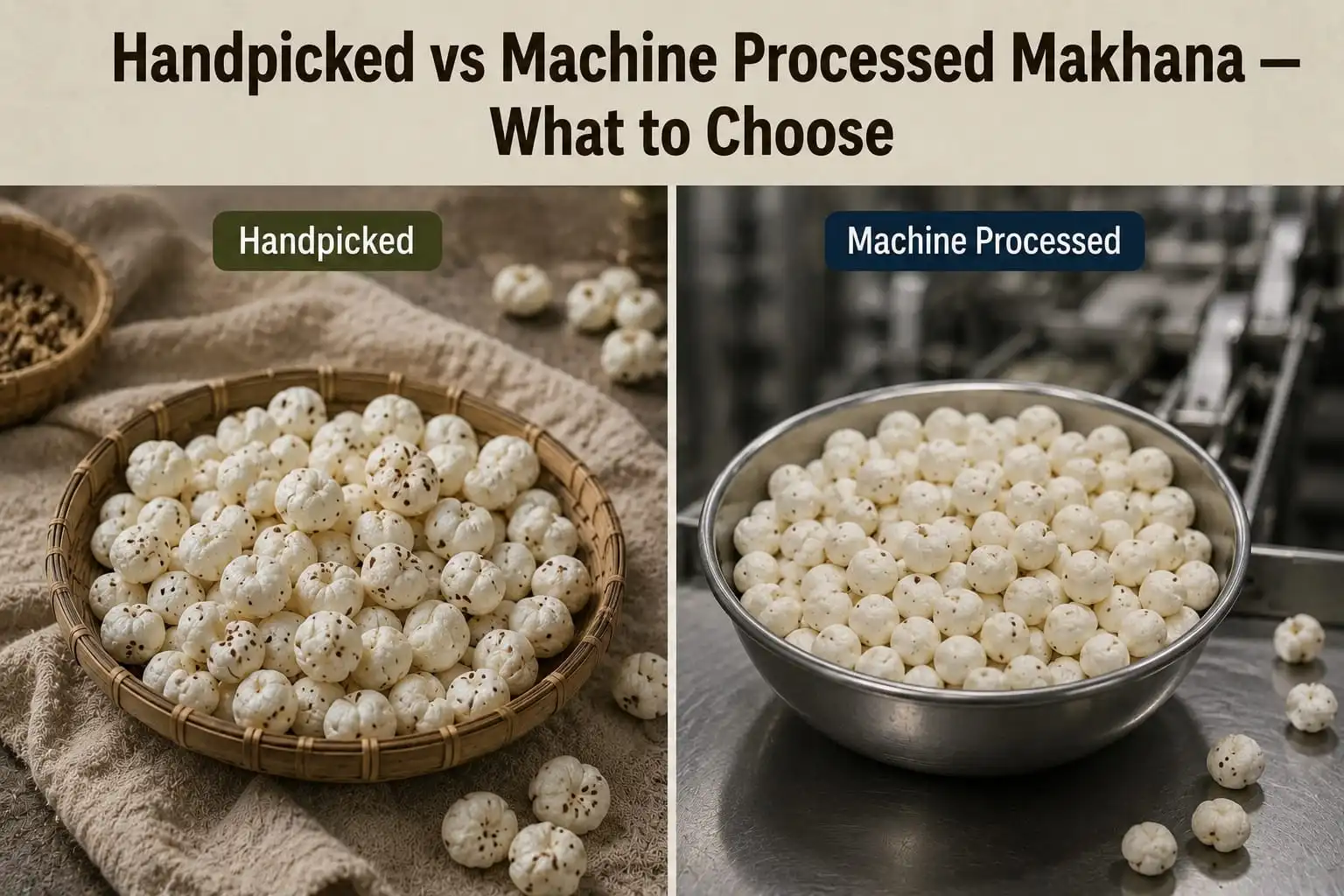
Makhana, also known as fox nuts or gorgon seeds, has quickly become one of the most popular healthy snacks in India and global markets. As demand grows, buyers are no longer just asking “Where to buy makhana?” — they’re asking a more important question: “Which type of makhana is better — handpicked or machine processed?”
This is especially important for wholesalers, retailers, exporters, and even conscious consumers who care about quality, consistency, and value. At first glance, both options may look similar, but in reality, there are clear differences in quality, grading, processing, pricing, and overall use case.
In this detailed guide, we’ll break everything down so you can make the right choice based on your business or personal needs.
Understanding How Makhana Is Processed
Before comparing the two, it’s important to understand how makhana reaches the market. Makhana is primarily grown in water bodies, especially in Bihar. After harvesting, the seeds go through multiple steps:
- Cleaning
- Drying
- Roasting
- Popping
- Sorting and grading
The key difference comes in the sorting and selection stage — this is where handpicked and machine processed makhana take different paths.
What Is Handpicked Makhana?
Handpicked makhana is sorted and selected manually by skilled workers. Each piece is carefully checked based on size, color, and quality. This traditional method focuses on precision rather than speed. Workers separate premium-grade makhana from lower grades by hand, ensuring a more refined final product.
Key Features of Handpicked Makhana:
- Carefully sorted by human inspection
- Better size uniformity
- Whiter and cleaner appearance
- Minimal broken pieces
- Premium quality output
This type of makhana is usually used for export, premium retail brands, and high-end packaging.
What Is Machine Processed Makhana?
Machine processed makhana uses automated systems for sorting and grading. Instead of manual inspection, machines categorize makhana based on size and weight. This method is faster and more efficient, especially for large-scale production.
Key Features of Machine Processed Makhana:
- Faster processing and sorting
- Suitable for bulk production
- Cost-effective
- Slight variation in quality
- Higher chances of mixed grading
This type is commonly used for local markets, bulk supply, and cost-sensitive buyers.
Handpicked vs Machine Processed Makhana (Quick Comparison)
Factor | Handpicked Makhana | Machine Processed Makhana |
Quality | Premium | Standard |
Sorting | Manual, precise | Automated |
Appearance | Uniform, white | Slight variation |
Broken Pieces | Minimal | More likely |
Cost | Higher | Lower |
Best For | Export, premium retail | Wholesale, bulk supply |
Key Differences Between Handpicked and Machine Processed Makhana
1. Quality Difference
Quality is the biggest differentiator between the handpicked and machine processed makhana.
Handpicked makhana goes through detailed manual inspection, which ensures:
- Better appearance
- Uniform size
- Higher-grade output
Machine processed makhana, while efficient, may include:
- Mixed sizes
- Slight discoloration
- More broken pieces
If quality is your priority, handpicked is the better option.
2. Pricing Difference
Price varies significantly between the two types.
- Handpicked makhana: Higher price due to labor and precision
- Machine processed makhana: Lower price due to automation
Businesses targeting premium customers can justify higher pricing with handpicked quality, while bulk traders may prefer machine processed for cost efficiency.
3. Consistency and Uniformity
Consistency matters a lot, especially for branding and exports.
Handpicked makhana offers:
- Uniform size
- Better visual appeal
- Consistent grading
Machine processed makhana may have:
- Slight variations in size
- Mixed grading in bulk lots
For branding and packaging, consistency gives a strong advantage.
4. Suitability for Different Business Types
Choosing between the two depends on your business model.
Handpicked Makhana is Best For:
- Premium brands
- Export businesses
- High-end retail packaging
Machine Processed Makhana is Best For:
- Wholesale traders
- Bulk supply businesses
- Price-sensitive markets
The “right choice” depends on your target customer.
5. Demand in Domestic vs International Markets
Global markets are more quality-focused.
International buyers usually prefer:
- Clean, white makhana
- Uniform size
- Proper grading
This makes handpicked makhana more suitable for export.
In domestic markets:
- Both types are used
- Pricing plays a bigger role
6. Impact on Profit Margin
Your choice directly affects your profit.
- Handpicked makhana → Higher selling price, better margins
- Machine processed makhana → Lower cost, volume-based profit
If you’re running a premium business, handpicked increases margins.
If you’re in wholesale, machine processed improves turnover.
7. Processing Speed and Scalability
Machine processing wins in speed.
- Faster sorting
- Higher production capacity
- Easier scaling
Handpicking is slower because it depends on manual labor.
For large-scale operations, machine processing is more practical.
8. Consumer Perception and Branding
Today’s consumers are more aware of what they buy.
Handpicked makhana is often perceived as:
- Premium
- Cleaner
- Higher quality
This perception helps brands:
- Charge more
- Build trust
- Position as a premium product
Which One Should You Choose?
There is no single correct answer — it depends on your goal.
Choose Handpicked Makhana if:
- You want premium quality
- You are targeting export markets
- You are building a brand
Choose Machine Processed Makhana if:
- You are focused on bulk supply
- You want lower investment
- You are targeting price-sensitive buyers
Many successful businesses use a mix of both depending on customer demand.
Conclusion
The handpicked and machine processed makhana have their place in the market. The difference comes down to quality vs cost, precision vs speed, and premium vs bulk positioning. If your focus is on quality, branding, and export markets, handpicked makhana is the better choice. If your goal is volume, affordability, and faster operations, machine processed makhana works well.
In the end, the smartest approach is not just choosing one — but choosing what fits your business model and customer demand.
You Can Also Read More About: Makhana for PCOD and hormonal health — what the research says
FAQs
1. What is the main difference between handpicked and machine processed makhana?
Handpicked makhana is manually sorted for better quality and uniformity, while machine processed makhana is sorted using machines for faster bulk production.
2. Which type of makhana is better for export?
Handpicked makhana is usually preferred for export because of its superior quality and consistent grading.
3. Is machine processed makhana safe to eat?
Yes, it is completely safe. The difference is mainly in sorting quality, not safety.
4. Can machine processed makhana be used for retail brands?
Yes, especially for mid-range or budget-friendly products.
5. Does processing method of makhan affect taste?
Not much because taste mostly depends on roasting and freshness, not sorting method.