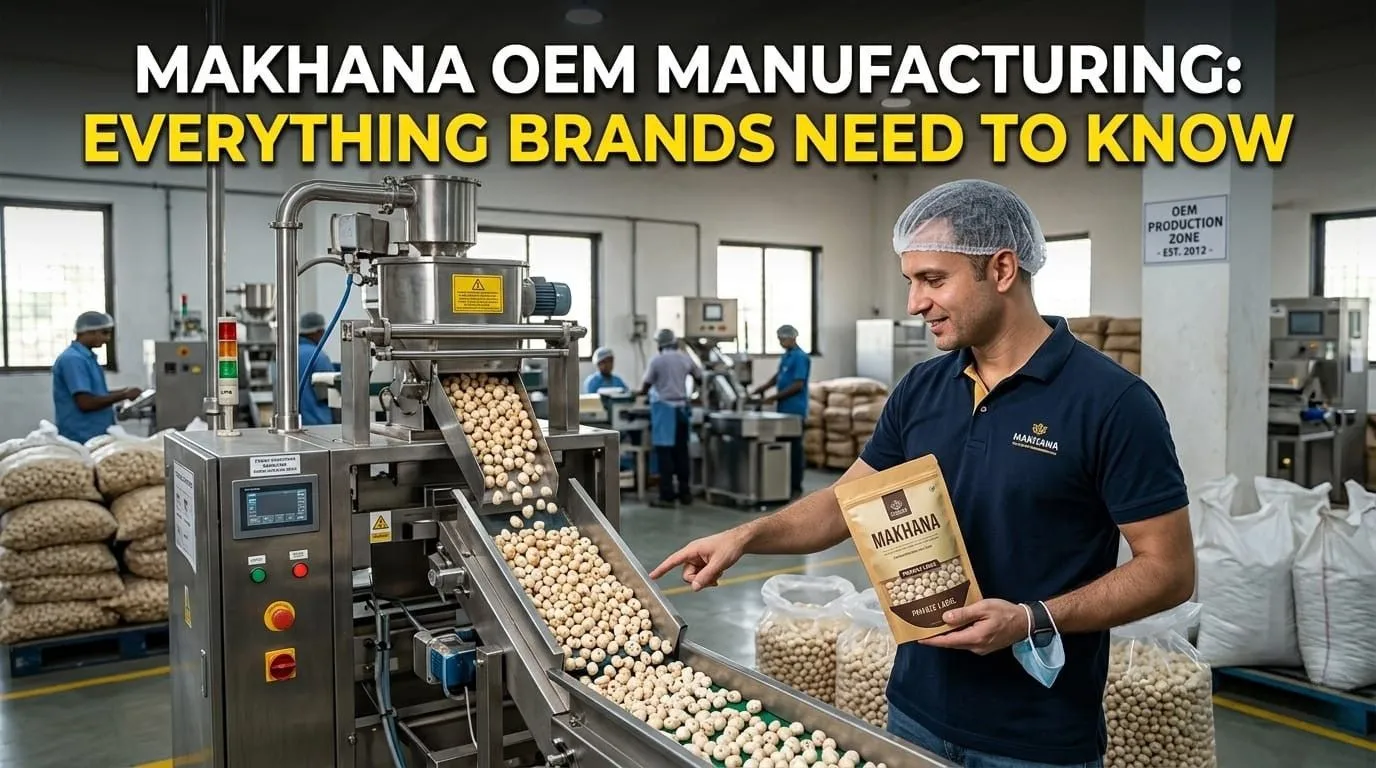
The global healthy snacking industry is growing rapidly, and makhana has become one of the fastest-rising products in this category. From supermarkets and health food stores to e-commerce platforms and export markets, the demand for roasted and flavored makhana is increasing every year.
As this demand grows, many businesses are entering the market with their own private-label snack brands, but setting up a complete manufacturing unit from scratch requires major investment, production expertise, sourcing networks, machinery, packaging systems, and quality control, that’s where Makhana OEM manufacturing becomes important. Today, many brands prefer working with OEM makhana manufacturers who already have the infrastructure, processing setup, sourcing network, and packaging capabilities. This allows businesses to launch their own makhana products faster without building a factory themselves.
In this detailed guide, we’ll explain everything brands need to know about makhana OEM manufacturing, including how it works, its benefits, important factors to consider, profit opportunities, quality standards, and how to choose the right manufacturing partner.
What Is Makhana OEM Manufacturing?
OEM stands for Original Equipment Manufacturing. In the makhana industry, OEM manufacturing means a third-party manufacturer produces makhana products for another brand under that brand’s own name and packaging.
Simply put:
- The manufacturer handles production
- The brand handles marketing and sales
This model has become extremely popular in the snack industry because it reduces setup costs and speeds up market entry.
How Makhana OEM Manufacturing Works
The process is usually simple and structured.
A brand approaches a makhana manufacturer and decides:
- Product type
- Flavor variants
- Packaging style
- Branding requirements
- Quantity requirements
The OEM manufacturer then handles:
- Sourcing raw makhana
- Roasting and processing
- Flavoring
- Packaging
- Labeling
- Bulk supply
The final product is delivered under the client’s brand name.
Why OEM Manufacturing Is Growing in the Makhana Industry
The makhana market is expanding very quickly due to rising demand for:
- Healthy snacks
- Gluten-free foods
- Low-calorie snacks
- Plant-based products
Because of this, many businesses want to launch makhana products without investing heavily in manufacturing infrastructure.
OEM manufacturing solves this problem by allowing brands to:
- Enter the market faster
- Reduce operational complexity
- Focus on sales and branding
This is one of the biggest reasons why private-label makhana brands are increasing rapidly in India and globally.
Why Brands Prefer OEM Makhana Manufacturing
1. Lower Initial Investment
Setting up a snack manufacturing unit from scratch requires significant capital investment, technical setup, workforce management, and operational planning. For startups and growing businesses, this can become financially challenging. OEM manufacturing solves this problem by allowing brands to use an already established production system instead of building their own factory.
This helps brands:
- Start with lower capital
- Reduce operational risk
- Enter the market faster
This is one of the main reasons private-label makhana brands are growing rapidly.
2. Faster Market Entry
Building a production facility takes time. From machinery installation to staff hiring and quality setup, the process can take several months or even years before products are ready for sale. OEM manufacturers already have fully operational systems in place, which allows brands to skip the lengthy setup phase and launch products much faster.
OEM manufacturers already have:
- Processing systems
- Skilled labor
- Existing supply chains
- Packaging capabilities
This allows businesses to focus directly on branding, marketing, and selling.
3. Access to Production Expertise
Makhana processing is not as simple as it looks. Product quality depends heavily on roasting methods, moisture control, grading, and overall processing experience. Experienced OEM manufacturers already understand these technical factors and have optimized production systems to maintain product consistency.
Important areas in makhana processing include:
- Roasting technique
- Crispness
- Moisture control
- Grading consistency
Poor processing can affect texture, taste, shelf life, and customer satisfaction.
Also Checkout: Best Makhana Manufacturer in India
Working with experienced manufacturers helps ensure:
- Better product consistency
- Better shelf life
- Better customer experience
Expertise becomes extremely important when building a long-term snack brand.
4. Easier Product Scaling
Many brands can manage small orders initially, but problems usually begin when demand starts increasing. Scaling production independently often requires additional machinery, larger factories, more labor, and higher operational costs. OEM manufacturers generally operate larger setups designed for bulk production, which makes scaling much easier.
OEM manufacturers often support:
- Bulk production
- Continuous supply
- Flexible scaling capability
This allows brands to grow without constantly worrying about manufacturing limitations.
Benefits of easier scaling:
- Better supply consistency
- Faster order fulfillment
- Lower operational stress during growth
Scaling becomes smoother when production infrastructure is already established.
5. Focus on Branding and Sales
Manufacturing requires daily operational involvement, quality monitoring, labor management, and logistics coordination. Handling all of this internally can reduce the time available for business growth activities. By outsourcing production to an OEM partner, brands can focus more on building their market presence and increasing sales.
This allows businesses to focus on:
- Marketing
- E-commerce growth
- Retail distribution
- Customer acquisition
Instead of spending time managing factory operations, brands can invest their energy into expanding visibility and building customer trust.
Important Factors Brands Should Check Before Choosing an OEM Manufacturer
Choosing the right OEM partner is extremely important because product quality directly affects your brand reputation.
1. Product Quality and Consistency
In the snack industry, consistency is extremely important. Customers expect the same taste, texture, freshness, and appearance every time they buy a product. Even small quality differences can affect customer trust and repeat purchases. This is why brands should carefully check the manufacturer’s product standards before starting long-term production.
Important quality factors to check:
- Crispness
- Color consistency
- Product freshness
- Uniform size grading
Inconsistent quality can directly damage a brand’s reputation in the market.
2. Manufacturing Capacity
Choosing a manufacturer only for current demand is your biggest mistake because as your brand grows, production requirements may increase rapidly. Your OEM partner should have enough infrastructure and operational capability to support future scaling without affecting supply timelines or product quality.
Important things to ask about:
- Daily production capacity
- Bulk supply capability
- Lead times
- Scalability
A manufacturer with limited capacity may struggle during high-demand periods.
3. Food Safety Certifications
Food safety certifications are extremely important, especially if you plan to sell through supermarkets, online platforms, or export markets. Certifications help build buyer confidence and indicate that the manufacturer follows proper hygiene, safety, and quality control systems.
Important certifications may include:
- FSSAI
- ISO
- HACCP
- Export certifications
These certifications often reflect stronger operational standards and better production practices.
Why certifications matter:
- Improve buyer trust
- Support export approvals
- Ensure better quality control
Certified manufacturers are generally considered more reliable for long-term partnerships.
4. Packaging Quality
Packaging plays a major role in modern snack branding. Even a good product can struggle in the market if the packaging looks poor or fails to protect freshness. Proper packaging not only improves appearance but also helps maintain shelf life and product quality during transportation and storage.
Good packaging helps with:
- Shelf life
- Product protection
- Premium appearance
- Customer trust
Brands should check whether the manufacturer provides professional packaging solutions.
Important packaging features to look for:
- Food-grade packaging
- Proper sealing
- Attractive retail-ready options
Strong packaging improves both product protection and brand perception.
5. Flavoring Capability
Flavored makhana is one of the fastest-growing segments in the healthy snack industry. Consumers now prefer a variety of taste options beyond plain roasted makhana. A good OEM manufacturer should be capable of maintaining flavor consistency while handling different seasoning styles and customized formulations.
Check whether the manufacturer can handle:
- Multiple seasoning styles
- Consistent flavor coating
- Customized formulations
Poor flavor consistency can negatively affect customer satisfaction and repeat purchases.
6. MOQ (Minimum Order Quantity)
Minimum Order Quantity (MOQ) is another important factor, especially for startups and smaller brands. Some manufacturers only accept very large production orders, which may not be practical for businesses entering the market. Flexible MOQ options help brands test products without taking excessive inventory risk.
Startups should check:
- Minimum order requirements
- Flexibility for smaller batches
- Trial production availability
Also Read: Handpicked vs Machine Processed Makhana
Future of Makhana OEM Manufacturing
The future looks very strong because:
- Healthy snacking is growing globally
- Plant-based foods are expanding
- Gluten-free demand is increasing
- Consumers want cleaner snacks
As more brands enter the makhana category, OEM manufacturing will continue growing rapidly.
How Hybite Foods Supports OEM Makhana Manufacturing
Brands looking for reliable OEM support often prefer manufacturers with strong quality control and scalable production systems.
Hybite Foods focuses on:
- Quality makhana sourcing
- Consistent processing
- Private label manufacturing
- Modern packaging solutions
- Bulk and export-ready supply
This helps businesses launch and scale makhana brands more efficiently in both domestic and international markets.
Conclusion
Makhana OEM manufacturing has become one of the smartest ways for brands to enter the healthy snacking industry without building a complete production setup from scratch. As global demand for healthy, gluten-free, and plant-based snacks continues to rise, private-label makhana brands are growing rapidly across India, the USA, Europe, and the Middle East. The right OEM partner helps businesses maintain quality, scale production, improve packaging, and enter markets faster while reducing operational complexity.
You Can Also Read More About: Why Makhana Is Becoming a Superfood in the USA and Europe
FAQs
1. What is Makhana OEM manufacturing?
Makhana OEM manufacturing is a process where a manufacturer produces makhana products under another company’s brand name.
2. What products can be made through OEM makhana manufacturing?
Manufacturers usually offer plain roasted, flavored, organic, and private-label makhana products.
3. Can OEM manufacturers provide custom packaging?
Yes, many OEM manufacturers offer private-label packaging and customized branding solutions.
4. What is MOQ in OEM manufacturing?
MOQ stands for Minimum Order Quantity, which is the minimum production quantity required by a manufacturer.
5. Which company provides OEM makhana manufacturing services?
Brands like Hybite Foods provide OEM and private-label makhana manufacturing solutions for businesses.