The makhana business is growing rapidly across wholesale, retail, export, and private-label markets. As more businesses enter the healthy snacking industry, one term that buyers frequently hear is MOQ (Minimum Order Quantity).
If you are starting a makhana brand, buying in bulk, or planning private-label production, understanding MOQ is extremely important because it directly affects your investment, pricing, packaging, and inventory planning. In this guide, we’ll explain what MOQ means in the makhana business, common MOQ expectations, factors that affect it, and how businesses can manage MOQ smartly before placing orders.
What Is MOQ in the Makhana Business?
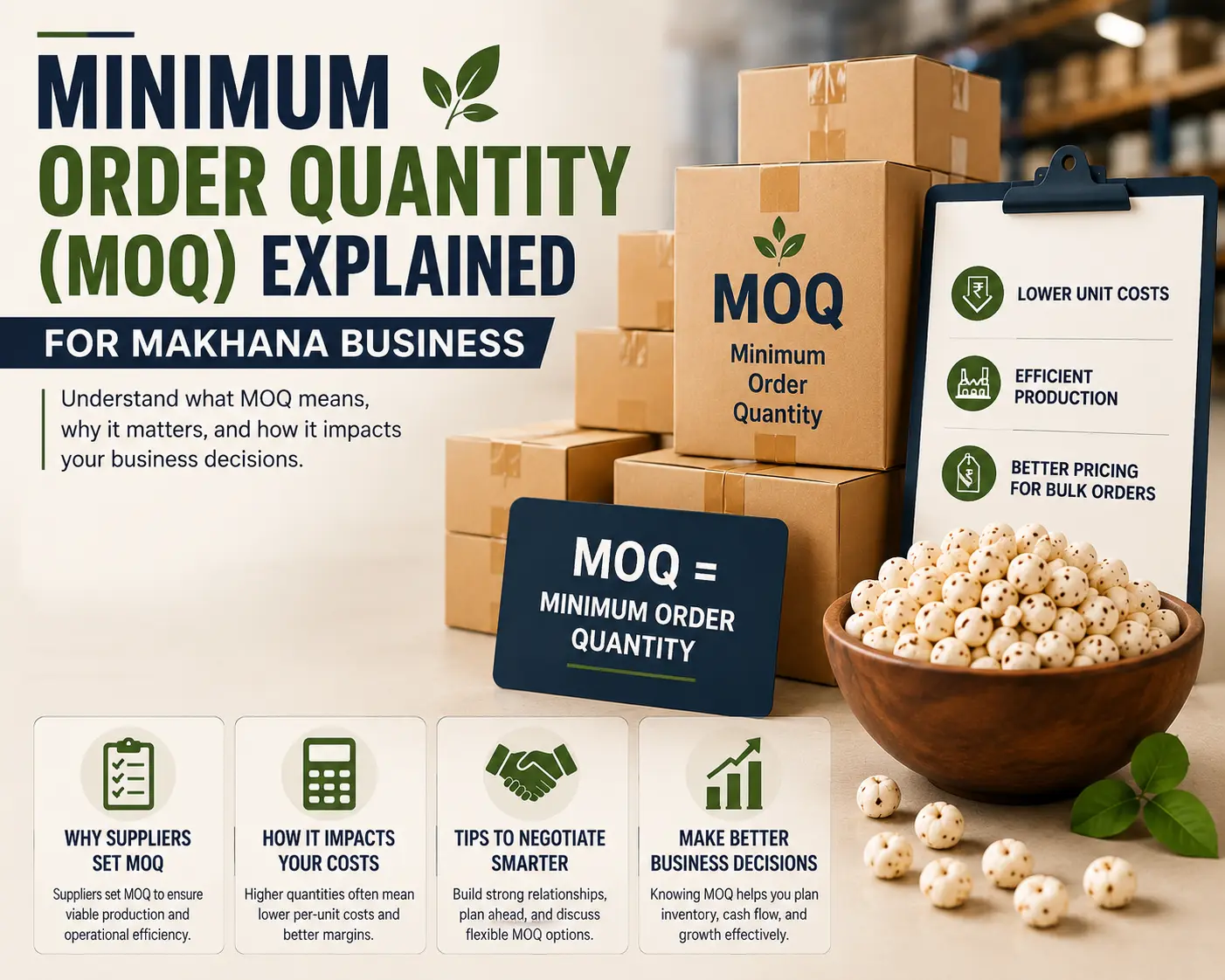
MOQ stands for Minimum Order Quantity, it is the minimum quantity of product a supplier agrees to sell or manufacture in one order.
For example:
- A wholesaler may require a minimum order of 50 kg
- A private-label manufacturer may require 500 packets
- An exporter may require bulk container quantities
MOQ is important because production, packaging, labor, and logistics involve operational costs and also suppliers need a certain order size to make production commercially viable.
Why MOQ Exists in the Makhana Industry
Many buyers assume MOQ is only about making larger sales, but there are several practical reasons behind it.
Suppliers set MOQ because of:
- Raw material procurement
- Packaging setup cost
- Machine operation cost
- Labor expenses
- Transportation efficiency
- Production planning
Smaller orders often increase operational cost per unit, which reduces profitability for manufacturers. So, this is especially true in flavored and private-label makhana production, where packaging and customization require additional setup work.
Common MOQ Types in the Makhana Business
MOQ is not the same across every business model. There are different types of suppliers that have different minimum order expectations.
1. Wholesale Makhana MOQ
Wholesale suppliers usually offer lower MOQ compared to manufacturers.
This model is common for:
- Retailers
- Small distributors
- Local snack sellers
- New businesses
Typical wholesale MOQ may range from:
- 10 kg
- 25 kg
- 50 kg
- 100 kg
2. OEM / Private Label MOQ
OEM manufacturing usually has higher MOQ because customized production involves:
- Packaging setup
- Branding
- Printing
- Flavor processing
- Batch production planning
Common OEM MOQ ranges include:
- 500 packets
- 1000 packets
- 2000+ units
Some manufacturers may offer smaller trial batches, but pricing is usually higher for low-volume orders. Private-label businesses should always discuss MOQ clearly before finalizing production.
3. Export MOQ
Export orders usually involve larger quantities because international logistics and shipping costs are higher.
Export MOQ may depend on:
- Country
- Shipping method
- Packaging standards
- Container load requirements
Some exporters work with:
- 100 kg trial orders
- 500 kg bulk orders
- Full container shipments
Large-scale buyers often negotiate pricing based on volume.
Check about: Makhana OEM Manufacturing: Everything Brands Need to Know
Factors That Affect MOQ in Makhana Business
MOQ is influenced by multiple operational and commercial factors.
1. Packaging Type
Packaging plays a major role in deciding MOQ in the makhana business. The more customized and premium the packaging is, the higher the MOQ usually becomes. This happens because manufacturers need additional setup, printing, and packaging material arrangements before production starts.
Examples of packaging that may increase MOQ:
- Printed pouches
- Premium zip-lock packaging
- Branded retail packets
These packaging styles require minimum printing quantities and setup costs. On the other hand, simple bulk packaging usually allows lower MOQ and is more suitable for beginners.
2. Plain vs Flavored Makhana
MOQ also depends on if you are buying plain makhana or flavored makhana. Flavored variants generally require higher MOQ because the production process involves additional seasoning and coating work.
Flavored makhana may require:
- Flavor preparation
- Batch production
- Additional processing
Plain makhana is comparatively simpler to process, which is why suppliers often offer more flexible order quantities for it.
3. Product Grade and Size
Different grades of makhana have different availability levels in the market. Premium-quality makhana is usually available in limited quantities, which can increase MOQ requirements.
Premium grades often include:
- Larger size
- Better whiteness
- Higher crispness
Since these grades are considered high-value products, suppliers may prefer larger orders for better inventory management.
4. Custom Branding Requirements
Private-label and custom branding projects usually come with higher MOQ expectations. This is because manufacturers need to manage multiple additional processes before production begins.
Custom branding may involve:
- Custom printing
- Brand labeling
- Packaging inventory
- Design setup
The more customized your product is, the higher the MOQ may become due to increased operational and packaging costs.
5. Supplier Capacity
The size and operational capacity of a supplier also affect MOQ. Large manufacturers generally prefer bigger orders because they operate high-volume production systems. Smaller suppliers may offer lower MOQ, but they may also face limitations such as:
- Limited consistency
- Lower scalability
- Slower production capacity
This is why businesses should focus on finding the right balance between flexible MOQ and reliable long-term supply capability.
MOQ and Pricing Relationship
MOQ directly affects pricing.
Generally:
- Higher MOQ = lower per-unit cost
- Lower MOQ = higher per-unit cost
This happens because operational costs get distributed across larger quantities.
For example:
- Packaging cost reduces at scale
- Transportation becomes more efficient
- Production setup becomes more economical
This is why bulk buyers usually receive better pricing.
Common MOQ Mistakes Businesses Make
1. Ordering Too Much Initially
Many new businesses overestimate demand and order excessive inventory.
2. Ignoring Packaging Costs
Custom packaging can significantly increase MOQ and production expenses.
3. Choosing Suppliers Only Based on Low MOQ
Very low MOQ suppliers may not always offer:
- Consistent quality
- Reliable supply
- Proper processing standards
4. Not Clarifying MOQ Properly
Businesses should always confirm:
- Product MOQ
- Flavor MOQ
- Packaging MOQ
- Repeat order requirements
Browse: Traceability in Makhana Supply Chains
Conclusion
MOQ is an important part of the makhana business because it directly affects investment, pricing, packaging, and inventory planning. Understanding how MOQ works helps businesses make smarter purchasing decisions and avoid unnecessary risk, especially in wholesale, private-label, and export markets.
The key is to choose the right supplier, start with practical order quantities, and focus on consistent quality. Brands like Hybite Foods support businesses with quality makhana supply and flexible solutions for growing market needs.
FAQs
1. What does MOQ mean in the makhana business?
MOQ stands for Minimum Order Quantity, which is the minimum quantity a supplier agrees to sell or manufacture.
2. Why do makhana suppliers set MOQ limits?
MOQ helps suppliers manage production, packaging, labor, and operational costs efficiently.
3. Is MOQ different for wholesale and private-label orders?
Yes, private-label and OEM orders usually have higher MOQ due to custom packaging and branding requirements.
4. Does flavored makhana have higher MOQ?
Generally yes, because flavored makhana requires additional processing and seasoning setup.
5. Does premium-grade makhana require higher MOQ?
In many cases yes, because premium-quality makhana has limited availability.