
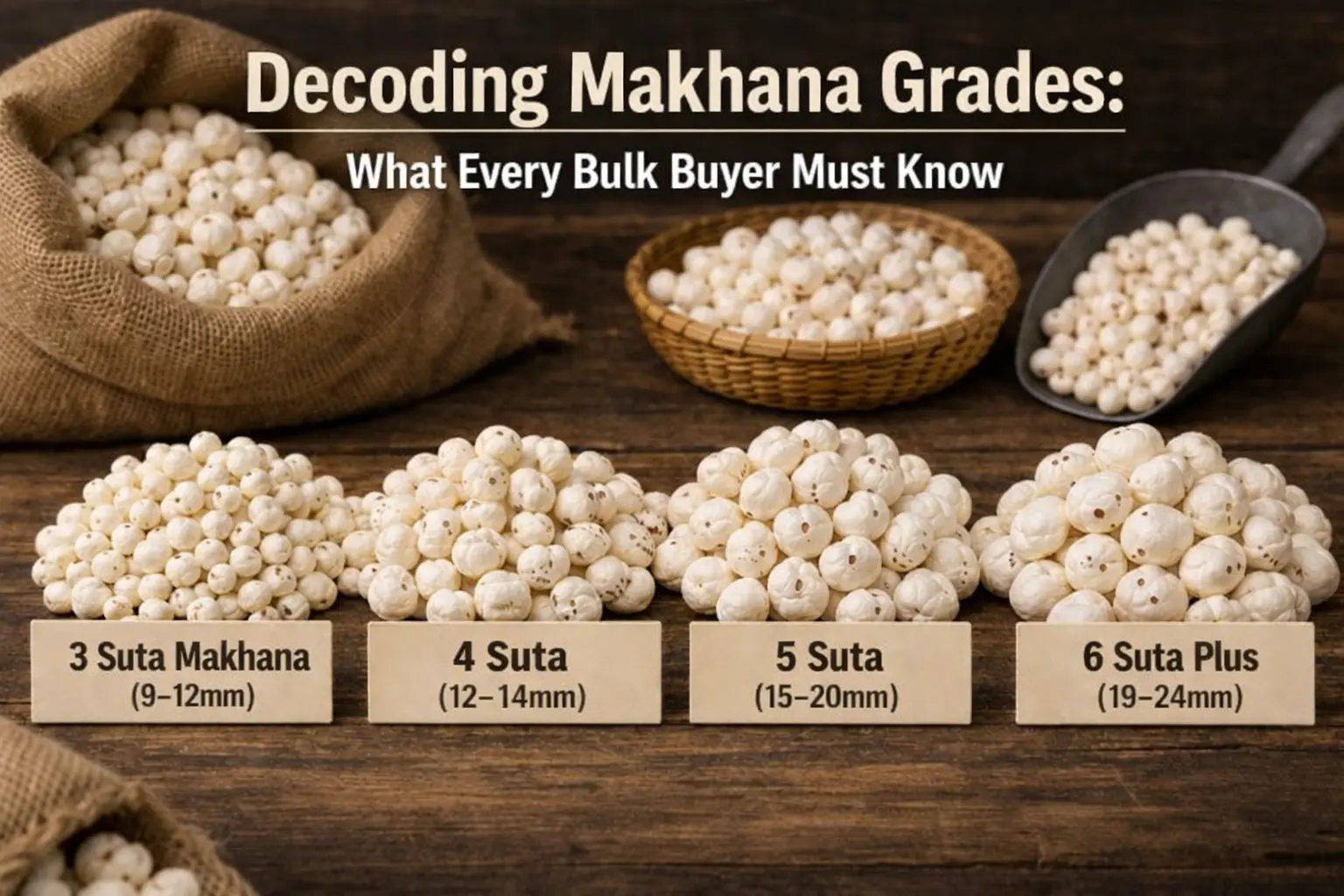
When you’re sourcing makhana in bulk, understanding makhana grading is one of the first—and most important—steps. Many buyers ignore this, but it directly impacts product quality, pricing, and customer satisfaction. If you don’t pay close attention to grading, you may end up with inconsistent batches, unclear pricing, or makhana that doesn’t match your market standards. For importers, wholesalers, and food brands, understanding makhana grading is not just a technical detail—it’s a business decision.
In this guide, we’ll break down how makhana grades are defined, what they actually mean in real-world supply, and how to choose the right grade for your business.
What is Makhana Grading?
Makhana grading is the process of sorting fox nuts based on size, appearance, texture, and overall quality after the popping stage (when seeds turn into white kernels). Since makhana is a natural product, every batch varies slightly. Grading helps standardize this variation so bulk buyers receive uniform, consistent products that meet specific requirements.
In simple terms, grading ensures:
- Consistency across bulk orders
- Better pricing clarity
- Predictable product quality
- Easier resale or processing
The Standard Makhana Grading System
Before finalizing any makhana bulk order, it’s important to understand how makhana is actually graded in the real market. While some suppliers use general terms like premium or standard, most serious manufacturers—especially from Bihar—follow a Suta-based grading system, which is more precise and widely accepted in bulk trade.
Makhana grades are mainly defined by size (in mm), expansion, appearance, and uniformity. Knowing these specific grades helps buyers choose the right product for retail, export, or processing.
1. 6 Suta Plus Makhana (19–24 mm)
6 Suta Plus Makhana is the highest grade of makhana available, known for its large size, excellent expansion, and premium appearance. These kernels are carefully selected to maintain uniformity, making them ideal for buyers who prioritize quality and visual appeal. It also performs exceptionally well during roasting, giving a crisp and light texture.
These are:
- Extra-large, well-expanded kernels
- Bright white and clean appearance
- Highly uniform in size and shape
- Very low breakage
Best For:
Premium exports, luxury retail packaging, and high-end branded products
2. 5 Suta Plus Makhana (15–24 mm)
5 Suta Plus Makhana is a premium-grade option that offers excellent quality while being slightly more cost-effective than 6 Suta. It maintains good size, clean appearance, and overall consistency, making it a popular choice among bulk buyers.
These are:
- Large-sized, well-popped kernels
- Clean and fairly uniform look
- Good expansion quality
- Low breakage
Best For:
Premium retail brands, export markets, and high-quality packaged products
3. 5 Suta Makhana (15–20 mm)
5 Suta makhana provides a balanced mix of quality and pricing, making it one of the most commonly used grades in bulk supply. It offers decent size and appearance with slight variation, making it suitable for both retail and general distribution.
These are:
- Medium to large-sized kernels
- Slight variation in size
- Good overall appearance
- Moderate breakage
Best For:
Retail packaging, supermarkets, and general bulk supply
4. 4.5 Suta Plus Makhana (14–24 mm)
4.5 Suta Plus includes a wider size range, which makes it slightly less uniform compared to higher grades. However, it still maintains acceptable quality for commercial use and is widely used in mid-range markets.
These are:
- Mixed medium to large kernels
- Noticeable size variation
- Acceptable color and texture
- Slightly higher inconsistency
Best For:
Wholesale markets, blended packaging, and mid-range product lines
5. 4 Suta Plus Makhana (12–24 mm)
4 Suta Plus Makhana is a cost-effective grade where size consistency is lower, but it still remains suitable for bulk supply. It is commonly chosen by buyers who focus more on pricing than uniform appearance.
These are:
- Medium-sized kernels with variation
- Less uniform structure
- Moderate breakage
- Slightly duller appearance
Best For:
Bulk distribution, budget-friendly retail, and general trade supply
6. 4 Suta Makhana (12-14mm)
4 Suta Makhana is a standardized, small-sized grade that prioritizes functionality and value over visual uniformity. While it lacks the expansive size of higher grades, it maintains reliable popping quality and is a staple for buyers looking for consistent supply at a competitive price point. This grade is particularly popular for domestic markets where the end-use application does not require large, showpiece kernels.
These are:
Small, uniform kernels within a tight size bracket (12–14 mm)
Consistent expansion suitable for standard roasting
Moderate to lower breakage compared to mixed-lot grades
Clean appearance, though smaller in size
Best For:
Standard retail packaging, value-conscious consumers, local markets, and as a base ingredient for ready-to-eat snack mixes
7. 3 Suta Murrah Makhana
3 Suta Murrah is the smallest and most economical grade, mainly used where visual appeal is not the priority. Despite its size, it still holds nutritional value and is widely used in processing industries.
These are:
- Small-sized kernels
- High variation in size and shape
- Higher breakage ratio
- Less visual consistency
Best For:
Food processing, makhana powder, flavored snacks, and bulk resale
Key Factors That Define Makhana Quality
Beyond basic grading, experienced buyers don’t rely on labels alone—they evaluate specific quality parameters before finalizing bulk makhana orders.
1. Size and Expansion (Suta-Based Grading)
In the makhana industry, size is directly linked to Suta grading. Higher grades like 6 Suta Plus and 5 Suta Plus indicate larger, well-expanded kernels, which are considered premium. Proper expansion shows that the popping process was done correctly, resulting in better texture and higher market value.
2. Color and Appearance
Regardless of the grade, good quality makhana should have a bright white or creamy finish. Higher Suta grades usually maintain a cleaner and more polished look, while lower grades may show slight dullness or variation. Yellowish or uneven color is often a sign of poor processing.
3. Texture After Roasting
Texture is a key performance factor, especially for retail and snack brands. High-quality makhana—particularly in higher Suta grades—should become light and crispy when roasted. If the kernels turn chewy or dense, it usually indicates issues with moisture or processing.
4. Moisture Content
Moisture plays a major role in maintaining quality during storage and transport. Even in higher grades, excess moisture can reduce shelf life and affect crispness. Well-processed makhana should have low and controlled moisture levels to ensure long-term stability.
5. Breakage Ratio Within Grades
Each Suta grade should maintain consistency with minimal broken pieces. For example, 6 Suta Plus and 5 Suta Plus are expected to have very low breakage, while lower grades may naturally include more variation. Excessive breakage in higher grades is a clear red flag for buyers.
How Makhana Grading Impacts Pricing
In the makhana trade, pricing is closely tied to the Suta-based grading system. The size, uniformity, and overall appearance of the kernels directly influence how the product is valued in bulk markets.
- Higher Suta grades (like 6 Suta Plus and 5 Suta Plus) command higher prices due to their larger size, better expansion, cleaner appearance, and minimal breakage. These are considered premium and are often used for export and branded retail.
- Mid-range grades (like 5 Suta and 4.5 Suta Plus) offer a balance between quality and cost. They are slightly less uniform but still suitable for most retail and wholesale applications.
- Lower grades (like 4 Suta Plus and 3 Suta Murrah) are more affordable because they have smaller sizes, higher variation, and increased breakage. These are commonly used in bulk distribution or processing.
However, the goal for bulk buyers is not always to purchase the highest grade—it’s to select the right grade based on the end use.
For example:
- A premium snack or export brand may prefer 6 Suta Plus or 5 Suta Plus for better presentation and consistency
- A food processor or manufacturer may choose 4 Suta Plus or 3 Suta Murrah for cost efficiency and functional use
Understanding this balance between grade, pricing, and application helps buyers optimize both cost and product performance in the long run.
Grading for Different Industries (Application-Based Buying)
*In the commercial Makhana trade, grades are primarily determined by sieve size—the diameter of the raw, unpopped seed. The numeric system (3, 4, 4+, 5, 5+, 6+) is the industry standard for bulk transactions. Below is how these grades align with different business applications.*
Numeric Grade | Sieve Size (mm) | Characteristics | Best For | Why |
Grade 3 | 9–12 mm | Very small seeds; high density; limited popping expansion. | Industrial grinding, makhana flour, animal feed (low end). | Cost-effective for processing where visual appearance and size are irrelevant. |
Grade 4 | 12–14 mm | Small but uniform; creamish to white color; moderate popping yield. | Baby food products, makhana kheer (sweet pudding), value-added mixes. | Smaller size blends well into semi-liquid dishes and provides softer texture after cooking. |
Grade 4+ | 14–24 mm | Between small and medium; better popping ratio than Grade 4; fewer splits. | Mid-range snack manufacturing, hotel supplies, bulk export to price-sensitive markets. | Offers a balance between cost and quality; suitable for flavored snacks where uniformity is not critical. |
Grade 5 | 15–20 mm | Medium size; consistent popping; bright white color when processed well. | Ready-to-eat flavored snacks, retail pouches (economy segment), food service. | Reliable popping performance; widely accepted as the baseline for commercial snack production. |
Grade 5+ | 15–24 mm | Large size; excellent popping expansion; minimal broken pieces; premium appearance. | Premium retail packaging, gourmet snack brands, export to high-end markets (US, EU, Middle East). | Delivers superior puff and visual appeal; commands higher margins in branded retail. |
Grade 6+ | 19–24 mm | Extra-large; exceptionally rare; near-zero breakage; highest popping ratio. | Luxury gift packs, specialty exports, high-end Ayurvedic formulations. | Considered the "king" grade; limited availability; fetches the highest price per kg. |
Common Mistakes Bulk Buyers Should Avoid
Even experienced buyers can face quality issues if important details are overlooked during sourcing. When dealing with Suta-based makhana grades, a small mistake can directly impact product consistency, pricing, and customer satisfaction.
1. Mixed Suta Grades in One Batch
One of the most common issues is receiving a mix of different Suta sizes in a single lot. For example, combining 5 Suta with 4 Suta Plus affects uniformity, which can create problems in packaging, branding, and resale value. Always confirm that each batch follows a single, clearly defined grade.
2. Unclear or Non-Standard Grade Labels
Some suppliers use generic terms like “premium” or “best quality” without specifying the exact Suta grade. This creates confusion and makes it difficult to compare pricing and quality. Always ask for clear Suta-based grading (like 6 Suta Plus, 5 Suta, etc.) before finalizing orders.
3. High Moisture Content
Even in higher grades like 6 Suta Plus or 5 Suta Plus, excess moisture can reduce shelf life and affect crispness. It can also lead to fungal growth during storage or transit. Always check moisture levels, especially for export shipments.
4. Excessive Breakage in Higher Grades
Premium Suta grades are expected to have minimal breakage. If a batch labeled as 6 Suta Plus or 5 Suta Plus contains too many broken pieces, it indicates poor handling or improper processing. This can reduce both value and market acceptance.
5. Poor Packaging and Storage Standards
Even good-quality makhana can lose its value if not packed properly. Exposure to moisture, air, or rough handling during transit can damage kernels. Always ensure moisture-proof, food-grade packaging and proper storage conditions.
Final Thoughts
Understanding makhana grading—especially the Suta-based system—is essential for making informed bulk buying decisions. It’s not always about choosing the highest grade; it’s about selecting the right grade that fits your business model, pricing strategy, and end use. Higher grades like 6 Suta Plus and 5 Suta Plus are ideal for premium retail and export, where appearance and uniformity matter. On the other hand, grades like 4 Suta Plus or 3 Suta Murrah work better for processing and cost-sensitive applications. The real advantage comes from knowing how to balance quality, consistency, and pricing.
For importers, wholesalers, and food brands, this understanding goes a long way. It helps improve product consistency, reduce quality-related risks, and build stronger, long-term relationships with reliable suppliers. In a competitive market, getting the grading right is not just a detail—it’s a business advantage.
FAQs
1. What are the different grades of makhana?
Makhana is commonly graded using the Suta system, which is based on size and expansion. Popular grades include 6 Suta Plus, 5 Suta Plus, 5 Suta, 4.5 Suta Plus, 4 Suta Plus, and 3 Suta Murrah, each offering different levels of size, uniformity, and quality.
2. Which makhana grade is best for export?
For export markets, higher grades like 6 Suta Plus and 5 Suta Plus are usually preferred. These grades offer better size consistency, cleaner appearance, and minimal breakage, which are important for international quality standards.
3. How is makhana grading done?
Makhana grading is done after the popping process. The kernels are sorted based on size (Suta), color, texture, and breakage ratio to ensure uniform batches for bulk supply.
4. Does a higher Suta grade always mean better quality?
Higher Suta grades generally indicate better size and appearance, but the “best” grade depends on your use. For example, premium grades are ideal for retail, while lower grades may be more suitable for processing or bulk use.
5. Can bulk buyers request customized makhana grading?
Yes, many suppliers offer customized grading based on buyer requirements. Bulk buyers can request specific Suta grades, quality parameters, and packaging standards depending on their business needs.