The global demand for makhana—also known as fox nuts or lotus seeds—has exploded over the past decade. Once a traditional Indian snack confined to domestic kitchens, makhana is now a certified superfood gracing health food aisles from New York to Dubai. The numbers tell the story: India produces approximately 90% of the world's makhana, and international buyers are actively competing for access to this premium product.
But here's the question every smart procurement manager is asking: "Where exactly is this makhana coming from, and can I trust it?"
You're not just buying a snack. You're buying into a supply chain that starts in the ponds of Bihar, passes through multiple intermediaries, and ends at your warehouse. Without visibility into that journey, you're operating blind.
This is where traceability becomes your most powerful tool. Traceability isn't just a compliance checkbox—it's your ability to track makhana from a specific pond in Darbhanga to your packaging facility. It's your guarantee of quality, your shield against fraud, and your proof of authenticity for end consumers.
The Makhana Supply Chain: A Map of Hidden Risks
Before discussing traceability, you need to understand exactly what you're dealing with. The makhana supply chain is fragmented, traditional, and often opaque. Sourcing directly from a reputable makhana manufacturer in India is the first step to mitigating these risks.
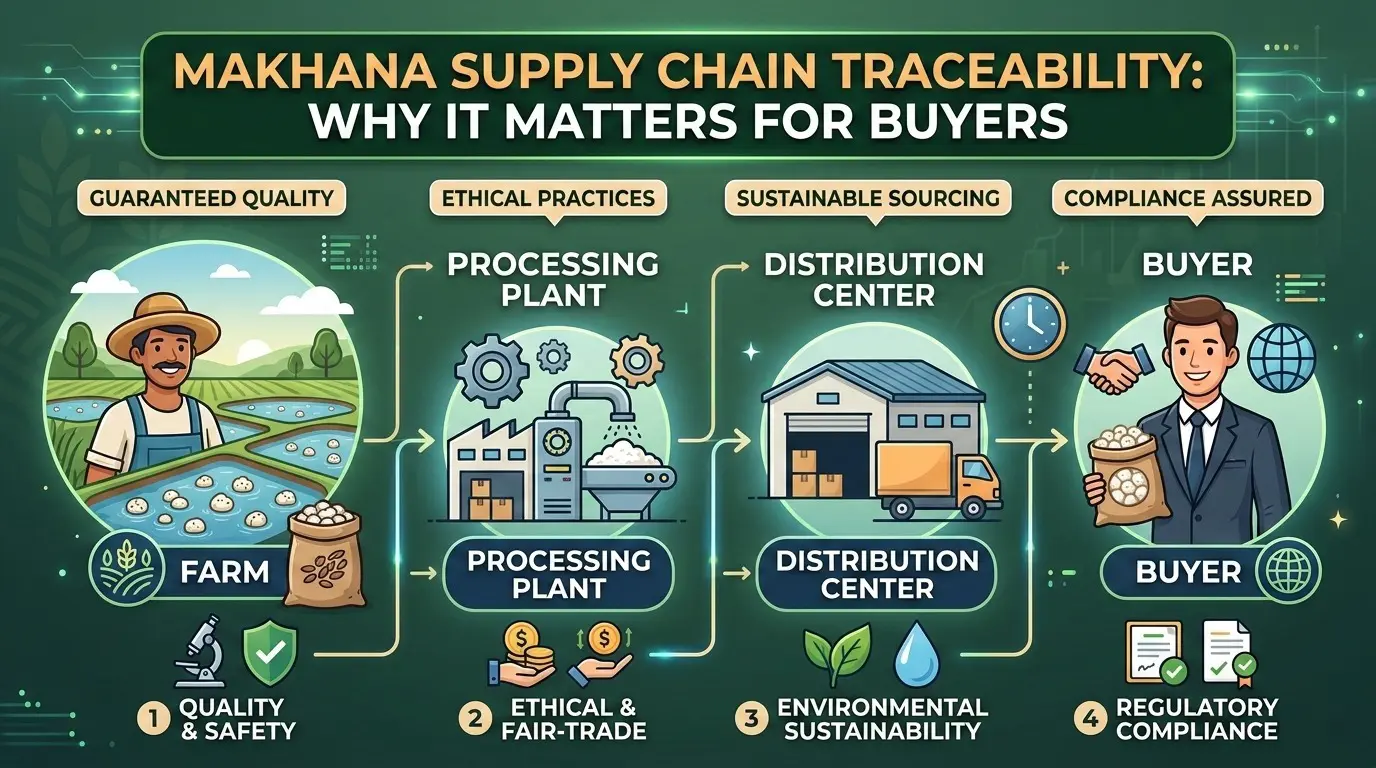
Here's how a typical batch travels from pond to port:
Cultivation → Harvesting → Local Aggregation → Wholesale Markets → Processing → Grading → Packaging → Export
Between the farmer and you, there can be five to seven intermediaries. At each handoff, two things happen: costs increase, and product identity weakens. By the time makhana reaches an export warehouse, it's nearly impossible to trace it back to its original source—unless someone has deliberately built a system to do so.
What Traceability Actually Means for You
Let's move beyond definitions. For a B2B buyer, traceability means one thing: the ability to connect a specific product in your warehouse back to a specific point of origin with verifiable data. When you source private label makhana, this level of detail is crucial for brand integrity.
In practical terms, this means your supplier should be able to tell you:
- The district and village where the raw seeds were cultivated
- The farmer group or FPO (Farmer Producer Organization) that supplied them
- The date of harvest and processing
- The specific batch or lot number for your shipment
- The quality test results corresponding to that exact lot
This isn't about theory. This is about having answers when questions arise.
Why Traceability Matters: The Business Case for Buyers
1. It Protects You from Quality Disasters
Imagine this scenario: You receive a 20-foot container of premium makhana. Upon inspection, you discover inconsistent sizing and an unusual texture across 30% of the shipment. Your production line is scheduled to start in 48 hours.
Without traceability: Your supplier says they'll "look into it." They have to manually review paper records, guess which batch might be problematic, and potentially inspect the entire container. Your production is delayed by weeks. Your customer faces stockouts. The financial damage multiplies.
With traceability: Your supplier isolates the specific lot number, checks their records, and identifies that the problem originated from a single processing batch on a specific date. They quarantine only the affected units, send replacements immediately, and investigate the root cause at the processor level. Your production resumes with minimal delay.
This isn't hypothetical. This is the difference between a supply chain partner and a commodity trader.
2. It's Your Only Defense Against Fraud
As makhana gains global popularity, the risk of misrepresentation grows. Unscrupulous suppliers may:
- Mix lower-grade makhana with premium varieties
- Mislabel non-GI products as authentic Mithila Makhana
- Conceal the true age of stored inventory
- Hide the use of unauthorized processing aids
Without traceability, you have no way to verify what you're actually receiving. You're relying entirely on trust—and in international trade, trust without verification is a liability.
3. It Simplifies Regulatory Compliance
Food safety regulations are tightening worldwide. The EU's General Food Law Regulation, the US FDA's Food Safety Modernization Act, and similar frameworks in other markets all require one fundamental capability: traceability.
When your shipment arrives at customs, officials may ask:
- Where was this grown?
- When was it processed?
- What are the pesticide residue levels?
- Can you show the chain of custody?
If your supplier cannot provide clear, documented answers, your shipment gets held—or rejected. Traceability isn't optional for compliance; it's mandatory.
4. It Creates Premium Brand Value
Here's the opportunity side of the equation. End consumers increasingly want to know where their food comes from. They're willing to pay more for products with a verifiable story.
When you can communicate to your customers that your makhana is traceable to specific farming communities in Bihar, you're not just selling a snack. You're selling authenticity, tradition, and trust. That translates to brand loyalty and premium pricing.
5. It Builds Resilient Supplier Relationships
Suppliers who invest in traceability are signaling something important: they're professional, forward-thinking, and committed to quality. These are the partners who will grow with you, who will prioritize your orders, and who will work with you when challenges arise.
When you choose traceable suppliers, you're building a supply chain that can withstand disruptions.
The Bihar Advantage: Why Origin Matters
The majority of the world's makhana comes from Bihar—specifically, the districts of Darbhanga, Madhubani, katihar, Purnia and surrounding areas. This region's unique wetland ecosystem produces makhana with distinct characteristics: larger seeds, better puffing quality, and superior taste.
In fact, Mithila Makhana has been awarded a Geographical Indication (GI) tag, recognizing it as a product with specific qualities derived from its geographic origin.
Here's what this means for you: If you're sourcing GI-tagged Mithila Makhana, you're paying for authenticity. But without traceability, you have no way to verify that you're actually receiving the genuine product. A GI tag on paper means nothing if the supply chain can't prove the product's journey from the designated region.
Traceability is the mechanism that turns a legal designation into a commercial reality. It's how you know your premium product is actually premium.
The Real Cost: What Buyers Don't See
Many buyers hesitate to demand traceability because they assume it will increase costs. This is a dangerous misconception.
Let's be direct: Traceability isn't a cost—it's an investment that pays for itself by preventing catastrophic losses.
Consider what you're already risking:
Risk Factor | Potential Cost Without Traceability |
Rejected shipment at customs | Full product cost + freight + demurrage + lost sales |
Quality recall | Refunds + logistics + brand damage + customer churn |
Fraud/mislabeling | Paying premium for non-premium product indefinitely |
Compliance failure | Legal penalties + market access restrictions |
Compare this to the marginal cost of working with suppliers who maintain proper traceability systems. The math is clear: you can't afford not to demand transparency.
How to Verify Traceability: A Buyer's Checklist
You now understand why traceability matters. Here's exactly how to verify it when evaluating suppliers for bulk makhana contracts.
Step 1: Demand Lot-Level Documentation
Don't accept generic assurances. Ask for:
- Unique lot numbers on every shipment. Every batch should have a reference that ties it to specific production records.
- Lot tracking sheets. Can the supplier show you a document that traces a specific lot from farmer procurement through processing to your container?
- Batch-specific lab reports. Insist on third-party test results (pesticide residue, aflatoxins, moisture content) that correspond to your specific lot number, not a generic certificate.
Step 2: Verify the Chain of Custody
Ask these questions directly:
- "Where did the raw seeds for this batch come from—specific district and village?"
- "Do you source directly from farmers, or through aggregators? If through aggregators, how do you maintain separation between sources?"
- "Can you show me your Goods Inward register for this product? Does it list the source of raw materials?"
Step 3: Audit Processing Segregation
Traceability breaks down when materials from different sources are mixed. Ask:
- "When you receive raw makhana from different farmers, do you keep them segregated, or do you combine them?"
- "How do you ensure that a specific output batch can be linked back to specific input materials?"
Step 4: Confirm GI Tag Verification (If Applicable)
If you're sourcing Mithila Makhana:
- "How do you verify that makhana claiming GI status actually comes from the designated region?"
- "What documentation do you maintain to prove geographic origin?"
Step 5: Test Their Response to the "Six-Month Question"
Pose this scenario: "If I discover a quality issue with this shipment six months from now, what is your exact process for investigating the cause?"
A supplier with real traceability will describe a clear process: locate the lot number, pull production records, identify the source batch, and investigate the specific stage where the issue originated. A supplier without traceability will give vague assurances.
Their answer tells you everything.
The Technology Edge: What's Coming
The makhana industry is evolving. Forward-thinking suppliers are adopting:
- Digital records at the FPO level — Mobile apps that record transactions at the farm gate, creating the first digital link in the chain.
- ERP systems in processing facilities — Tracking inventory, production batches, and quality tests electronically.
- QR codes on packaging — Allowing buyers (and eventually consumers) to scan and view the product's journey.
These technologies aren't science fiction. They're already being implemented by progressive suppliers who understand that transparency is the future of food trade.
When you find a supplier investing in these systems, you've found a partner worth keeping.
How Hybite Foods Approach Traceability
At Hybite Foods, we believe that transparency isn't an afterthought—it's the foundation of how we do business. Our approach to traceability is built on three principles:
1. Direct Farmer Relationships
We work closely with farming communities in Bihar's premium makhana-growing regions, reducing intermediaries and maintaining clear documentation from the source.
2. Batch-Level Tracking
Every shipment we prepare carries unique lot information that links back to specific procurement and processing records. When you receive makhana from us, you receive a product with a verifiable history.
3. Quality Documentation:
We maintain comprehensive records of processing, testing, and handling. Our clients receive batch-specific documentation that supports their own compliance and quality assurance needs.
This isn't about marketing. It's about building supply chains that work better for everyone—farmers, buyers, and ultimately, consumers.
Frequently Asked Questions
- Will demanding traceability increase my costs?
In the short term, working with traceable suppliers may mean paying a fair price for genuine quality. In the long term, traceability prevents costs—rejected shipments, recalls, compliance failures—that far outweigh any premium. Consider it risk insurance.
- Can small suppliers provide traceability?
Yes. Traceability isn't about expensive technology—it's about discipline. A small supplier with good records and segregated processing can provide traceability. A large supplier with chaotic systems cannot.
- What's the difference between traceability and basic documentation?
Basic documentation proves something exists. Traceability proves you can connect it. A certificate proves a facility is licensed. Traceability proves your specific lot came from that facility on a specific date.
- How do I verify a supplier's traceability claims?
Use the checklist in this guide. Ask specific questions, request lot-level documentation, and test their response to the "six-month question." A serious supplier will welcome your questions.
- Is all makhana from Bihar GI-tagged?
No. The GI tag applies specifically to Mithila Makhana produced in designated districts according to traditional methods. Other regions also produce makhana, and quality varies. Traceability helps you verify what you're actually getting.
- What records should I keep as a buyer?
Maintain lot numbers for every shipment, corresponding lab reports, and supplier communications about origin. This creates your own traceability chain and protects you when questions arise downstream.
- How is the Indian government supporting traceability?
Government initiatives including the proposed Makhana Board aim to bring structured policy and infrastructure to the sector. This will likely accelerate traceability adoption among serious exporters.
- Is traceability worth the effort for small buyers?
Yes. The risks are the same regardless of order size. A small contaminated batch can damage your brand just as thoroughly as a large one. Protect yourself from day one.