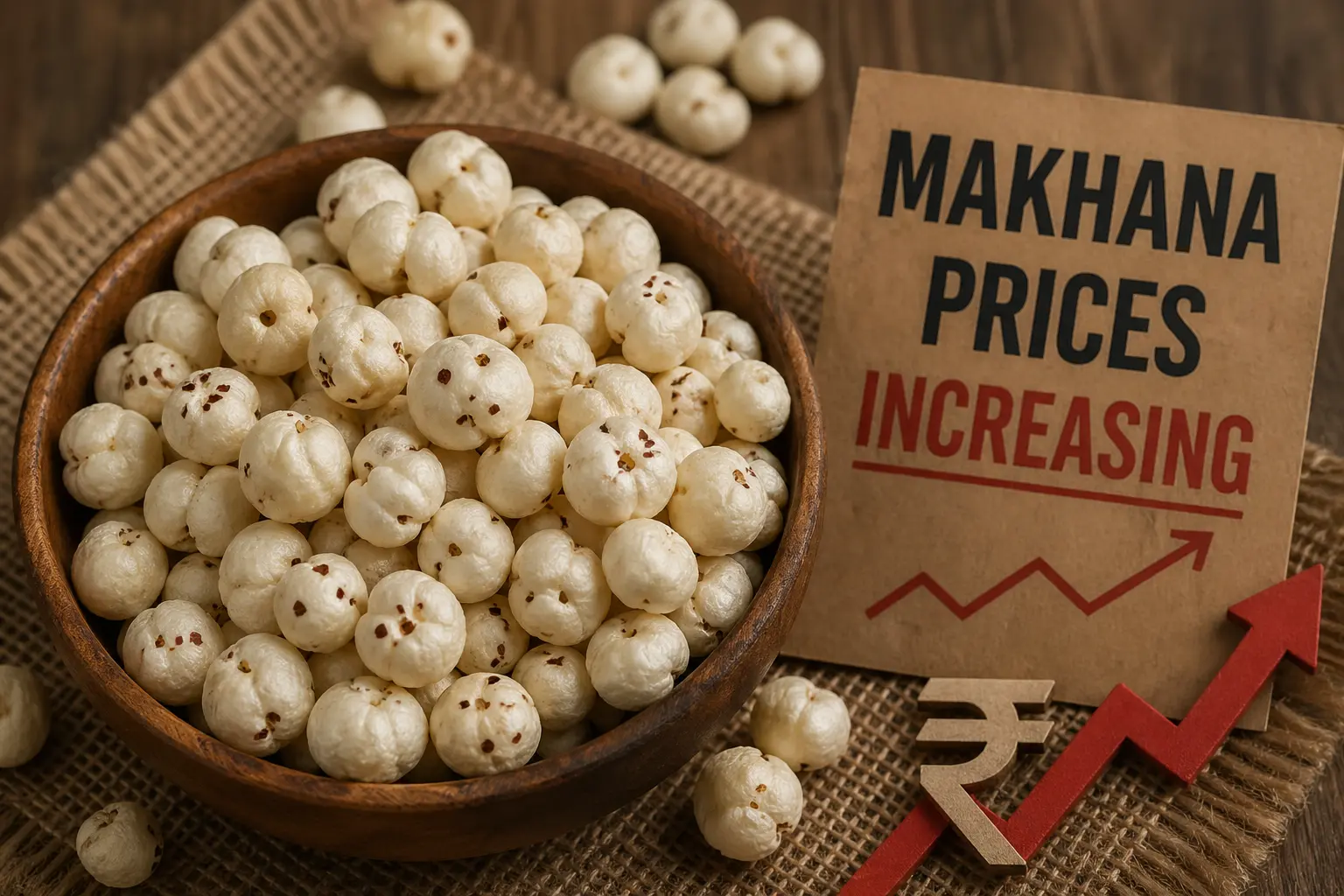
If you’ve noticed that makhana prices in India are rising rapidly, you’re not imagining it. Over the last few years, makhana has shifted from a traditional snack to a premium “superfood,” and that shift has changed everything, from demand to supply, pricing, and global trade. Today, if you’re a consumer, retailer, or B2B buyer, one question keeps coming up:
Why is makhana getting so expensive in India?
Let’s break this down in a clear, practical way so you understand what’s actually driving the price increase — and what it means going forward.
Makhana Price Trend in India (Quick Overview)
Before diving into reasons, look at how prices have moved:
- ₹500/kg (approx. 2020–2022)
- ₹950–₹1250/kg (2025)
- ₹1400+ in some retail markets
In some cases, prices have increased by 30%+ within a short period This is not normal inflation — this is a structural shift in the market.
The Real Reasons Behind Rising Makhana Prices
1. Explosive Demand in India and Globally
The biggest reason is simple: demand has increased faster than supply.
Makhana is no longer a niche product. It has become:
- A healthy snack alternative
- A weight-loss-friendly food
- A plant-based, gluten-free option
As health awareness rises, more people are replacing chips and fried snacks with makhana.
Globally, the demand is even stronger. Countries like the US, UK, UAE, and Australia are importing Indian makhana at scale. In fact, exports have grown sharply, with shipments increasing multiple times over the past few years
More demand + limited supply = higher prices
2. India Is the Main Producer (Supply Concentration Risk)
Here’s something critical most people don’t realize:
- India produces 80%+ of the world’s makhana
- Bihar alone contributes 80–90% of India’s production
This means the entire global supply depends on a single region.
So when:
- Weather changes
- Production drops
- Logistics get affected
Prices rise quickly across the entire market.
Also Read: Makhana manufacturer in India
3. Labor-Intensive and Slow Production Process
Makhana is not like wheat or rice. It cannot be mass-produced easily.
The process includes:
- Cultivation in ponds
- Manual harvesting from water
- Drying and roasting
- Hand processing and grading
It is highly labor-intensive and time-consuming, which increases production cost Unlike automated crops, scaling production is difficult — and that limits supply.
4. Climate Change and Weather Impact
It plays a huge role in makhana production.
Common issues include:
- Erratic rainfall
- Drying ponds
- Flooding in Bihar
These directly affect yield and quality.
Even a small drop in production can push prices higher because supply is already limited
5. Rapid Growth in Export Demand
Export demand is one of the biggest drivers of price increase.
- India’s makhana exports are growing at ~39% CAGR
- Export value crossed ₹255 crore in 2024–25
As more international buyers enter the market:
- Bulk Orders are exported
- Domestic supply reduces
- Prices rise in India
This is why retail prices have surged in recent years.
6. Health Trend and Superfood Positioning
Makhana is now marketed as a superfood, and that has changed its pricing power.
Consumers associate it with:
- Weight loss
- Clean eating
- Fitness diets
As a result:
- Demand has shifted from occasional to daily consumption
- Premium pricing has become acceptable
This is similar to how quinoa and chia seeds became expensive over time.
7. Supply Chain Gaps and Middlemen
The makhana industry is still largely unorganized.
Challenges include:
- Multiple intermediaries
- Lack of direct farmer-to-buyer connections
- Fragmented supply chains
This increases:
- Procurement cost
- Transportation cost
- Final selling price
In many cases, the farmer gets less — but the final buyer pays more.
8. Seasonal Production and Price Fluctuations
Makhana is not produced year-round.
- It has a seasonal harvesting cycle
- Supply varies throughout the year
During lean periods:
- Supply drops
- Prices increase
During peak harvest:
- Prices may stabilize temporarily
This seasonal nature makes pricing unstable.
9. Increasing Processing and Packaging Costs
Modern makhana is no longer sold only in loose form.
Now it includes:
- Branded packaging
- Flavored variants
- Export-ready packaging
These add:
- Processing cost
- Packaging cost
- Branding cost
Premium packaging alone can significantly increase retail price.
10. Rising Popularity in Organized Retail & E-commerce
Earlier, makhana was sold mainly in local markets.
Now it is available in:
- Supermarkets
- Online platforms
- Health food stores
This shift has led to:
- Better branding
- Wider reach
- Higher pricing
Consumers are now willing to pay more for convenience and quality.
11. Government Focus and Industry Formalization
The Indian government has started focusing on the makhana sector.
Key developments:
- Makhana Board announced in Bihar
- Investment in processing and export infrastructure
While this is good for long-term growth, it also:
- Brings more visibility
- Attracts more buyers
- Increases demand
Which can push prices higher in the short term.
12. Quality Grading and Premium Segments
Not all makhana is the same.
Prices depend on:
- Size (bigger = premium)
- Color (whiter = better)
- Texture (crispness)
High-grade makhana used for:
- Export
- Premium brands
These command significantly higher prices than local varieties.
Why Prices Increased So Fast Recently
The recent surge is not due to one factor — it’s a combination of:
- Demand spike (domestic + export)
- Limited production scalability
- Climate impact
- Premiumization of the product
That’s why prices have nearly doubled in some markets within a short time
Will Makhana Prices Increase Further?
Short answer: Yes, but gradually.
Reasons:
- Demand is still growing
- Export market is expanding
- Health trend is not slowing down
However:
- Government support may improve production
- Better infrastructure may stabilize supply
So instead of sharp spikes, we may see steady long-term price growth.
What This Means for Buyers and Businesses
For Consumers
- Expect higher prices compared to traditional snacks
- Quality matters more than price
For Retailers
- Opportunity to sell premium products
- Higher margins in flavored variants
For Exporters
- Strong global demand
- Need for quality consistency
For Wholesalers
- Bulk sourcing becomes more important
- Reliable makhana suppliers is the best option
Conclusion
Makhana prices in India are rising due to strong demand, limited production, and growing export markets. As it shifts from a traditional snack to a premium health food, pricing is becoming more stable at higher levels rather than dropping.
For buyers and businesses, the focus should be on consistent quality and reliable sourcing. Working with trusted suppliers like Hybite Foods can help ensure better quality, proper grading, and a steady supply in a competitive market.
You Can Also Read More About: How to Start a Makhana Wholesale Business
FAQs
1. Why are makhana prices increasing in India?
Prices are rising due to higher demand, limited production, export growth, and increasing processing costs.
2. Does export demand affect makhana prices?
Yes, higher exports reduce domestic supply, which pushes prices up in India.
3. Which state produces the most makhana in India?
Bihar is the largest producer, contributing the majority of India’s makhana supply.
4. Will makhana prices decrease in the future?
Prices may stabilize, but a major drop is unlikely due to consistent demand growth.
5. Is makhana business still profitable despite high prices?
Yes, strong demand and good margins make it a profitable business opportunity.
Lorem ipsum dolor sit amet, consectetur adipiscing elit. Ut elit tellus, luctus nec ullamcorper mattis, pulvinar dapibus leo.