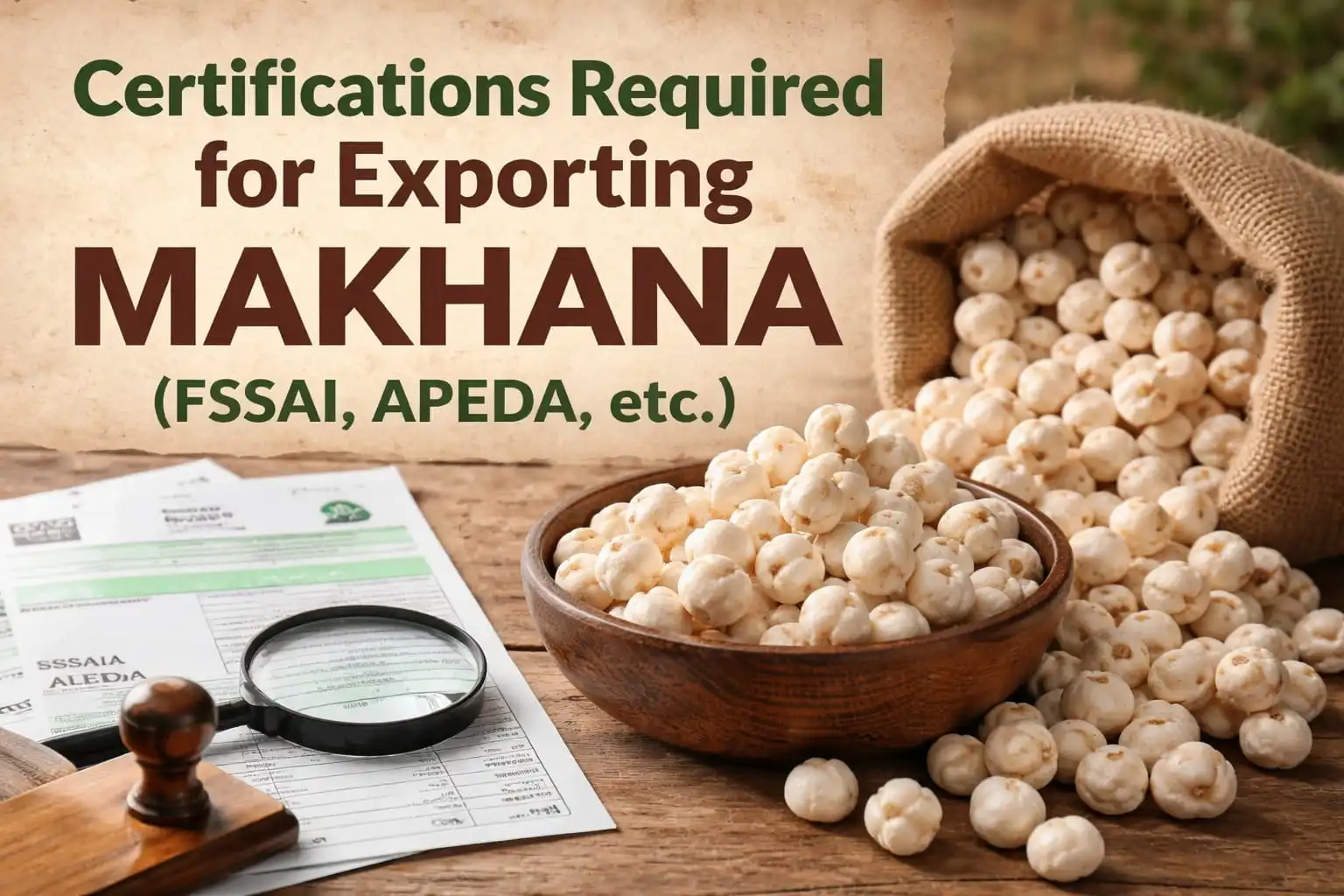
The global demand for makhana is growing steadily, and Indian exporters are in a strong position to benefit from it, but entering the export market is not just about sourcing and selling — compliance and certifications play a important role in it. If you’re planning to export makhana, understanding the required licenses and certifications is essential. Without proper documentation, shipments can get delayed, rejected, or even banned in international markets.
In this guide, we’ll break down the certifications required for exporting makhana, explain why they matter, and help you set up your export business in the right way.
Why Certifications Are Important for Makhana Export
Before you start applying for different licenses, it’s important to understand why certifications matter so much in the makhana export business. When you enter international markets, you are not just competing on price — you are competing on trust, consistency, and compliance.
Global buyers today are more careful, because they want assurance that the product they are sourcing meets proper food safety standards, follows hygienic processing methods, and can be traced back to its source if needed. This is especially important in the food industry, where even small quality issues can lead to major losses. Certifications act as proof that your business follows the right processes. They make your product more reliable in the eyes of buyers and help you avoid unnecessary risks in the export process.
What Export Buyers Focus On:
- Food safety standards
- Consistent product quality
- Traceability in the supply chain
- Compliance with international regulations
How Certifications Help Your Business:
- Build trust with global buyers
- Avoid legal issues and shipment delays
- Open doors to premium international markets
- Improve your brand credibility and value
In simple terms, certifications are not just a formality — they are the foundation of a successful and sustainable makhana export business.
Essential Certifications Required for Exporting Makhana from India
1. FSSAI License (Food Safety and Standards Authority of India)
When you are dealing with any food product, safety and hygiene become the top priority. In India, the Food Safety and Standards Authority of India (FSSAI) is the main authority that regulates food businesses. For anyone planning to export makhana, getting an FSSAI license is not just important — it’s mandatory.
This license ensures that your makhana is processed, handled, and packed following proper food safety standards. It also builds confidence among buyers that your product meets basic quality requirements.
Why FSSAI is Required:
- Mandatory for all food-related businesses
- Ensures safe processing and handling of makhana
- Builds credibility with domestic and international buyers
Types of FSSAI Licenses:
- Basic (for small businesses)
- State license
- Central license (required for export businesses)
If you’re planning to export, you must apply for an FSSAI Central License.
2. APEDA Registration
For exporting agricultural products like makhana, APEDA registration with Agricultural and Processed Food Products Export Development Authority is essential. This organization supports exporters by providing guidelines, market insights, and export-related assistance. APEDA plays a key role in promoting Indian agricultural products globally and helps businesses enter international markets more smoothly.
What APEDA Does:
- Promotes export of agricultural products
- Provides export guidelines and support
- Helps in international market access
Why APEDA Registration is Important:
- Mandatory for exporting makhana
- Required for export documentation
- Helps in accessing government schemes and benefits
Without APEDA registration, you cannot legally export makhana from India.
3. IEC Code (Import Export Code)
Before you start any export activity, you need an Import Export Code (IEC) issued by the Directorate General of Foreign Trade (DGFT). This code acts as a unique identity for your business in international trade. It is one of the first and most important steps in setting up your export business.
Why IEC is Required:
- Mandatory for any import or export activity
- Acts as a unique identification number
- Required for customs clearance
Without IEC, you won’t be able to ship goods internationally.
4. GST Registration
Even though exports are treated as zero-rated under GST, having a GST registration is still necessary for running a proper business. It helps you maintain financial transparency and ensures smooth documentation for transactions.
Why GST is Important:
- Required for invoicing
- Needed to claim tax benefits and refunds
- Helps maintain proper business records
Proper GST compliance keeps your operations legally secure and organized.
5. Phytosanitary Certificate
Since makhana is an agricultural product, many importing countries require a phytosanitary certificate. This document confirms that the product is free from pests, diseases, and harmful contaminants. It is usually issued by plant quarantine authorities after inspection.
Why It Matters:
- Mandatory for many international markets
- Ensures product safety and quality
- Required during customs clearance
Without this certificate, your shipment may get rejected at the destination port.
6. Certificate of Origin
A Certificate of Origin (COO) verifies that the makhana you are exporting is produced in India. This is an important document required by customs authorities in many countries. It also helps buyers understand the authenticity and sourcing of the product.
Why It Is Needed:
- Required for customs clearance in importing countries
- Helps in availing trade benefits under agreements
- Builds trust with international buyers
This certificate is usually issued by chambers of commerce or export councils.
7. USFDA Registration (For USA Market)
If you are targeting the United States market, registration with the U.S. Food and Drug Administration (USFDA) is mandatory. Any food facility exporting to the USA must be registered with the FDA under the Bioterrorism Act, and shipments must comply with FDA food safety regulations.
Key Requirements:
- FDA Food Facility Registration — renewed every two years
- Prior Notice submission before each shipment to the USA
- Compliance with FDA labeling, packaging, and food safety standards
- Adherence to FSMA (Food Safety Modernization Act) regulations
Why It Matters:
- Mandatory for all food products entering the US market
- Non-registered shipments will be detained or refused at US ports
- Builds confidence among US importers, retailers, and distributors
Without USFDA registration, your makhana cannot legally enter the United States market.
8. Halal Certification (For Islamic Markets)
Halal certification is essential for exporting makhana to Islamic countries such as the UAE, Saudi Arabia, Malaysia, Indonesia, and other markets with large Muslim populations. It certifies that the product and its entire supply chain — from processing to packaging — complies with Islamic dietary laws.
Key Markets Requiring Halal Certification:
- Middle East (UAE, Saudi Arabia, Qatar, Kuwait, Bahrain)
- Southeast Asia (Malaysia, Indonesia, Brunei)
- African countries with significant Muslim populations
Why It Matters:
- Mandatory for entering many Islamic country markets
- Required by importers and major retail chains in Muslim-majority countries
- Increases market reach and consumer confidence significantly
- Often required for government procurement in Islamic nations
Halal certification in India is issued by recognized bodies such as Jamiat Ulama-i-Hind Halal Trust and Halal India Pvt. Ltd.
9. BRC Global Standard Certification (BRCGS)
The British Retail Consortium Global Standard (BRCGS) for Food Safety is one of the most respected international food safety certifications. It is widely demanded by UK and European retailers, supermarkets, and global food brands as a prerequisite for supplier approval.
Why BRC Certification is Important:
- Mandatory requirement for supplying to major UK and European retailers (e.g., Tesco, Sainsbury's, Walmart)
- Demonstrates commitment to food safety, quality, and legal compliance
- Reduces need for individual buyer audits, saving time and cost
- Enhances brand reputation and opens doors to premium retail markets
BRC Certification Grades:
- Grade AA / A — Highest level; preferred by premium retailers
Grade B / C — Acceptable but with corrective action requirements
10. Quality Certifications (Optional but Important)
This is very important because quality certifications can give your business a strong competitive advantage. They show that your product meets international standards and is suitable for premium markets. These certifications are especially useful if you are targeting large retailers or global brands.
Common Certifications:
- ISO certification
- HACCP (Hazard Analysis Critical Control Point)
- Organic certification (if applicable)
Why They Matter:
- Improve credibility and brand value
- Help you enter premium international markets
- Increase buyer confidence
Having these certifications can help you stand out in a competitive export market.
11 . Packaging and Labeling Compliance
Exporting makhana is not just about the product — packaging plays an equally important role. International buyers expect proper labeling, safe packaging, and compliance with their country’s regulations. Even a small mistake in labeling can lead to shipment rejection.
What You Need to Ensure:
- Proper labeling (ingredients, weight, origin)
- Use of food-grade packaging materials
- Compliance with importing country regulations
Good packaging not only protects the product but also enhances its market value and acceptance.
Step-by-Step Process to Get Export Certifications
If you’re starting from scratch, here’s a simple process to follow:
- Register your business
- Apply for GST registration
- Get your IEC code
- Apply for FSSAI license
- Register with APEDA
- Arrange quality and compliance certifications
- Prepare export documentation
Following this process step by step will help you avoid confusion and delays.
Common Challenges in Makhana Export Certification
Many new exporters face issues while setting up certifications.
Common Problems:
- Lack of clarity on required documents
- Delays in approval process
- Compliance with international standards
- Incorrect or incomplete paperwork
The best way to avoid these issues is to plan in advance and work with experienced suppliers and consultants.
Tips for Smooth Export Operations
To make your export journey easier:
- Keep all documents updated
- Work with reliable suppliers
- Follow proper quality checks
- Understand country-specific regulations
Consistency and compliance are key to long-term success in the export market.
How Certifications Impact Your Business Growth
Having proper certifications doesn’t just help with compliance — it also supports business growth.
Benefits:
- Builds trust with international buyers
- Opens doors to new markets
- Helps you charge premium pricing
- Reduces risk of shipment rejection
In a competitive market, certified businesses always have an edge.
Conclusion
Exporting makhana is a promising business opportunity, but success depends on how well you manage compliance and quality standards. Certifications like FSSAI, APEDA, IEC, and others are not just formalities — they are essential tools that help you build a reliable and scalable export business.
If you focus on getting the right certifications, maintaining quality, and understanding international requirements, you can create a strong presence in the global makhana market. Taking the time to set things up properly in the beginning will save you from bigger challenges later and help you grow with confidence.
You Cal Also Read More About: Global Demand for Makhana: Market Trends 2026
FAQs
1. What certifications are required to export makhana from India?
You need FSSAI license, APEDA registration, IEC code, GST registration, and other compliance certificates.
2. Is FSSAI required for makhana export?
Yes, an FSSAI Central License is mandatory for exporting food products.
3. What is APEDA registration for makhana export?
APEDA registration is required for exporting agricultural and processed food products from India.
4. How to get IEC code for export business?
You can apply for IEC through the DGFT website.
5. Is GST required for exporting makhana?
Yes, GST registration is necessary for documentation and compliance.
6. What is a phytosanitary certificate?
It ensures that agricultural products are free from pests and safe for export.
7. Can I export makhana without certification?
No, exporting without proper certifications can lead to legal issues and shipment rejection.
8. What is the role of DGFT in export?
DGFT issues the IEC code and regulates foreign trade policies.
9. Are quality certifications necessary to export makhana?
Not always mandatory, but they improve credibility and market access.
10. Is makhana export profitable business?
Yes, due to increasing global demand and growing health awareness makhana is a profitable business.