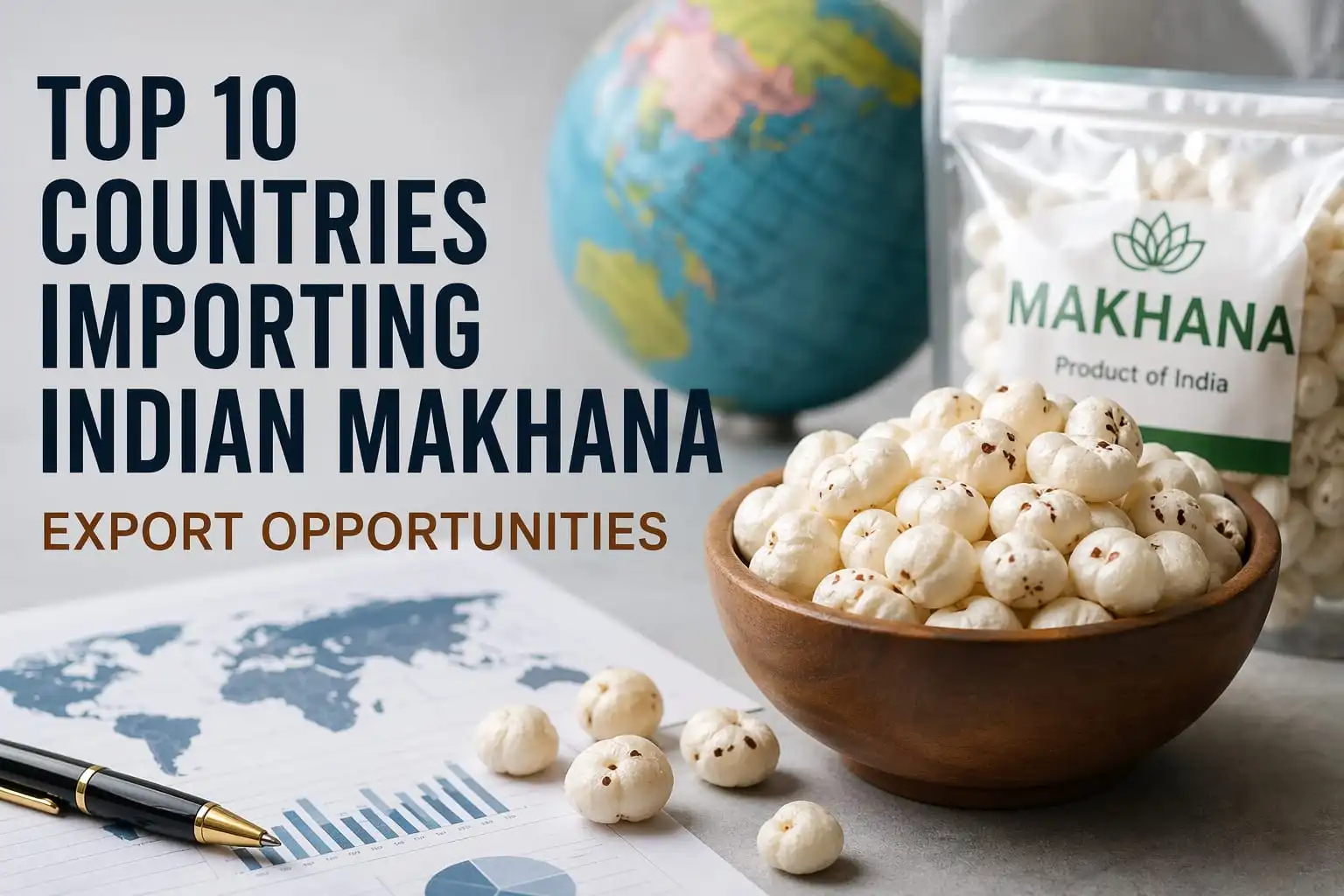
The global snacking industry is changing fast. Consumers are moving away from fried, processed foods and looking for clean, plant-based alternatives. That shift has quietly pushed Indian makhana (fox nuts) into the spotlight. What was once a traditional Indian snack is now showing up in supermarket shelves, health stores, and online marketplaces across the world.
For makhana exporters, wholesalers, and B2B buyers, this isn’t just a trend — it’s a growing opportunity.
In this guide, you’ll discover:
- Top countries importing Indian makhana
- Where demand is growing fastest
Top Countries Importing Indian Makhana
India remains the primary supplier of makhana globally, and most international markets rely on Indian sourcing for consistent quality and volume. Let’s look at the countries where imports are already strong.
1. United States
The United States is one of the largest and most established markets for Indian makhana. The demand here is driven by a strong shift toward healthier eating habits, where consumers are actively looking for alternatives to traditional processed snacks. With the rise of plant-based diets and clean eating trends, makhana is gaining popularity as a light, nutritious option.
Why demand is strong in the US:
- Growing preference for healthy and low-calorie snacks
- High demand for gluten-free and plant-based products
- Strong presence of premium and health-focused retail brands
2. United Kingdom
The UK market has been steadily growing, especially in the premium snack segment. Consumers are becoming more conscious about what they eat, and there is a clear shift toward natural, minimally processed foods. Makhana is slowly gaining visibility as a clean and healthy snack option in this space.
What drives demand in the UK:
- Increasing focus on organic and clean-label products
- Preference for high-quality, well-packaged snacks
- Strong demand in premium retail and health food stores
3. Canada
Canada is an important and growing market for makhana, with consumers showing a strong interest in health-focused foods. The market is open to global products, and makhana is being positioned as a better alternative to conventional snacks.
Key growth factors in Canada:
- Rising awareness of superfoods and healthy snacks
- Diverse consumer base open to international products
- Expansion of online and offline retail channels
4. United Arab Emirates (UAE)
The UAE is one of the most consistent and reliable markets for Indian makhana exports. The product already has strong acceptance due to cultural familiarity and a large Indian population. In addition, the UAE serves as a key distribution hub for the Middle East.
Why the UAE is strategically important:
- High demand driven by Indian and health-conscious consumers
- Strong retail and supermarket presence
- Acts as a gateway to nearby Middle Eastern markets
5. Australia
Australia has become a strong market for health-focused food products, and this is where makhana fits in naturally. Consumers here are moving away from processed snacks and actively choosing cleaner, lighter alternatives. As awareness around nutrition grows, makhana is slowly finding its place in supermarkets and online health stores.
Why demand is growing in Australia:
- Increasing preference for low-calorie snacks
- Strong demand for natural and minimally processed foods
- Rising popularity of clean-label products
This makes Australia a high-potential market, especially for premium and well-packaged makhana.
6. Germany
Germany is one of the most quality-driven markets in Europe, especially when it comes to food products. The demand for organic, natural, and sustainable snacks is already well established, and makhana is gradually entering this space as a premium alternative. Buyers in Germany are very particular about sourcing and standards, which makes it a high-value market for exporters who can meet expectations.
What German buyers focus on:
- Consistent product quality
- Proper certifications and compliance
- Sustainable and transparent sourcing
7. Netherlands
The Netherlands is not just a consumption market — it plays a strategic role in the European supply chain. A large portion of makhana imported here is redistributed across different EU countries, because of its strong logistics and trade infrastructure, many exporters use the Netherlands as an entry point into Europe.
Why it matters for exporters:
- Acts as a gateway to the European market
- Strong import-export and distribution network
- Access to multiple EU countries through one location
8. Singapore
Singapore may be small in size, but it is a premium and high-value market. Consumers here are willing to pay more for quality, packaging, and trusted food products. Makhana is gaining popularity as a healthy snack, especially among working professionals and fitness-conscious consumers.
Key demand factors in Singapore:
- Preference for high-quality, well-packaged products
- Growing interest in healthy snacking
- Strong retail and online food market
9. Malaysia
Malaysia is still an emerging market for makhana, but the demand is gradually building. As urban consumers become more health-aware, there is a noticeable shift toward better snack choices. Makhana is starting to gain attention as an alternative to fried snacks, especially in cities and modern retail outlets.
Why Malaysia is growing:
- Increasing health awareness
- Expanding retail and supermarket chains
- Rising demand for alternative snack options
10. Japan & South Korea
Japan and South Korea are early-stage markets for makhana, but the growth potential here is strong. Both countries have a well-developed food industry and a growing interest in functional and health-based foods. Consumers in these markets are very selective, which means quality and presentation play a huge role.
Why these markets matter:
- High demand for low-calorie snacks
- Strong interest in functional and nutrient-rich foods
- Preference for premium-quality imported products
For exporters, entering these markets early can create long-term advantages as demand continues to grow.
Where Demand Is Growing Fastest
While many countries are already importing Indian makhana, the pace of growth is not the same everywhere. Some regions are expanding much faster due to changing food habits, rising health awareness, and the shift toward better snacking options. For exporters, identifying these fast-growing markets is where the real opportunity lies.
Here’s a closer look at where demand is picking up the fastest.
1. North America (USA & Canada)
North America is currently leading in terms of rapid growth. Consumers are becoming more conscious about what they eat, and there is a clear shift toward clean, functional, and plant-based foods. Makhana fits perfectly into this category, which is why its demand is rising across both the United States and Canada. Retailers and snack brands are actively adding makhana to their product lines as a healthier alternative to traditional snacks.
Key growth drivers:
- Rising focus on clean and healthy eating
- Rapid expansion of plant-based diets
- Strong demand for gluten-free snack options
2. Europe (UK, Germany, Netherlands)
Europe is not just growing — it is evolving into a premium market for makhana. Consumers here are highly quality-conscious and prefer natural, organic, and sustainably sourced products. This makes makhana a strong fit, especially in health-focused retail segments. Countries like the UK and Germany are driving consumption, while the Netherlands plays a key role in distribution across Europe.
Why demand is increasing in Europe:
- High demand for organic and clean-label foods
- Strict quality and compliance standards
- Well-established healthy snack retail market
3. Middle East (UAE and Nearby Markets)
The Middle East continues to show stable and consistent growth in makhana demand. The UAE remains a central hub due to its strong retail infrastructure and diverse consumer base, with high purchasing power and familiarity with Indian food products, makhana is already well-accepted — and demand is steadily expanding into nearby countries.
Growth factors in this region:
- Strong consumer spending power
- Cultural familiarity with makhana
- Expanding supermarket and retail chains
4. Asia-Pacific (Australia, Singapore, Malaysia)
The Asia-Pacific region is emerging as a fast-growing market, particularly in urban areas where consumers are becoming more health-conscious. Modern retail formats and online platforms are making it easier for products like makhana to reach new customers. Australia is leading in terms of demand, while Singapore and Malaysia are showing promising growth.
Why this region is growing:
- Increasing awareness of healthy snacking
- Expansion of modern retail and e-commerce
- Rising disposable income among urban consumers
5. Emerging Markets (Japan & South Korea)
Japan and South Korea are still in the early stages of makhana adoption, but the growth potential is strong. Consumers in these countries are highly selective and prefer premium, functional foods that offer clear health benefits. As awareness increases, these markets are expected to grow quickly.
Reasons behind rising interest:
- Demand for premium and functional food products
- Growing preference for low-calorie snacks
- High acceptance of imported health-focused foods
For exporters, these fast-growing regions offer a clear direction — focus on markets where demand is rising now, and build a strong presence before competition increases.
What This Means for Exporters
Understanding where demand exists — and where it’s growing — gives you a clear direction.
Instead of targeting every market, focus on:
- High-demand countries for immediate business
- Fast-growing markets for future expansion
The smartest approach is to start with established markets like the USA, UAE, or UK, and then gradually move into emerging regions.
Conclusion
The global demand for Indian makhana is clearly moving in one direction — upward, but with stronger momentum in specific regions. Markets like North America and Europe are already driving volume, while regions such as Asia-Pacific and East Asia are opening up new growth opportunities.
For exporters and B2B businesses, success depends on understanding this shift. Instead of targeting every market at once, it’s smarter to focus on high-demand countries and gradually expand into fast-growing regions. With the right approach, makhana export is not just a short-term trend, but a long-term global opportunity.
You Can Also Read More About: Global Demand for Makhana: Market Trends 2026
FAQs
1. Which country imports the most Indian makhana?
The United States is currently one of the largest importers due to high demand for healthy snacks.
2. Is makhana export business growing globally?
Yes, global demand for makhana is increasing due to rising health awareness and clean eating trends.
3. Which are the fastest-growing markets for makhana?
North America, Europe, and Asia-Pacific are the fastest-growing regions for makhana.
4. Why is makhana popular in international markets?
It is low in fat, gluten-free, plant-based, and considered a healthy snack option.
5. What makes makhana suitable for global markets?
Its nutritional value, light texture, and versatility make it appealing to a wide range of consumers.